


 English
 Russia
 France
 Spain
Spain
 Arab
Arab

Author: Mia, Compressed Air Systems Engineer · Updated on August 12, 2026
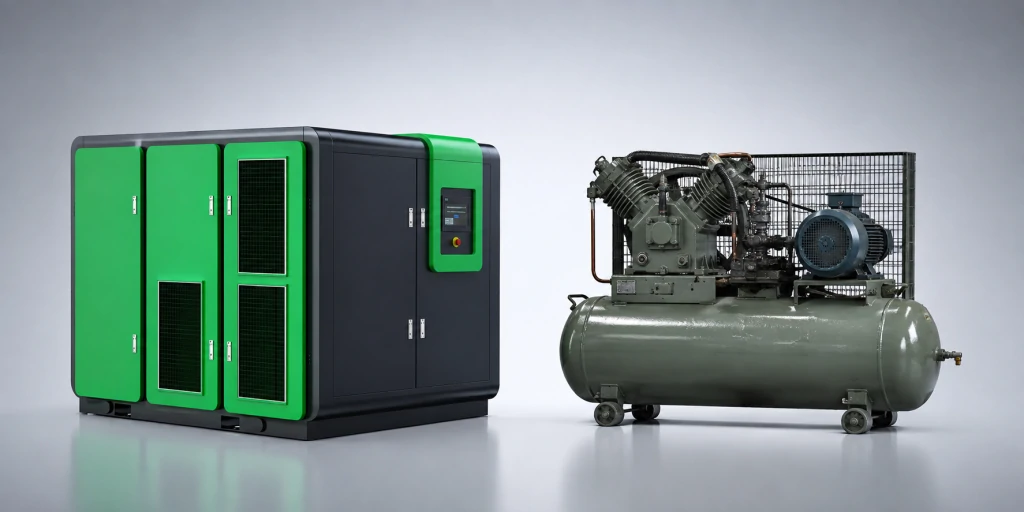
A screw vs reciprocating compressor decision usually comes down to one question. Do you run air tools nonstop, or only now and then? If your shop needs continuous, stable compressed air for hours, a rotary screw compressor is almost always the right call. Reciprocating (piston) units shine for light, intermittent duty at a lower upfront price. This guide breaks down the real differences—duty cycle, noise, maintenance, and 10-year cost. You can choose with confidence and avoid an expensive mistake.
Searching “air compressor vs piston compressor”? You’re in the right place. This bridge page frames the screw vs reciprocating compressor choice head to head. It also links back to our main screw air compressor Pillar for deeper detail.
Both designs compress air, but by different mechanics. The screw uses meshing helical rotors (see Wikipedia’s Air compressor overview for the full family of designs). The piston uses a reciprocating cylinder. By the end, you’ll know exactly which machine belongs in your facility.
Key Takeaways
- Rotary screw compressors run 100% continuous duty. Piston units are built for intermittent, stop-start use.
- Screw units deliver pulsation-free, stable airflow. Piston units pound, vibrate, and pulse with every stroke.
- Upfront cost favors piston (often 30–60% cheaper). But 10-year cost of ownership usually favors screw.
- Choose piston for low budgets, occasional DIY, or portable jobs. Choose screw for air more than a few hours daily.
- Need roughly 15+ CFM steadily or run several tools? For steady 15+ CFM or several tools at once, the screw compressor is the safer long-term buy.
Screw vs Reciprocating Air Compressor: The Side-by-Side Comparison
The single most important difference is duty cycle. Rotary screw units are built to run 100% duty around the clock. By contrast, a piston (reciprocating) unit is designed for intermittent duty. Push it to continuous use and it overheats or wears out. Everything else in the table below flows from that one design reality.
Here is the core screw vs reciprocating compressor comparison at a glance:
| Factor | Rotary Screw (Screw) | Reciprocating (Piston) |
| Duty cycle | 100% continuous, 24/7 capable | 50–80%, intermittent only |
| Airflow stability | Steady, pulsation-free | Pulsating with each stroke |
| Noise & vibration | Low (enclosed cabinet, ~60–75 dB) | High (pounding piston, 80+ dB) |
| Maintenance | Low; long service intervals, few wear parts | Higher; valves, rings, belts need regular care |
| Upfront purchase | Higher (premium for airend + VSD) | Lower (simple, mature design) |
| 10-year TCO | Lower per CFM delivered | Higher (energy + replacement parts) |
| Footprint | Compact, tankless or small buffer | Taller, needs large receiver tanks |
| Best-fit use | Plants, auto shops, packaging, sandblasting | DIY, occasional, remote/portable |
Want the mechanics behind that airend? Our deeper explainer on how does a screw air compressor work walks through the rotor, oil injection, and separation step by step.
Duty Cycle: The Deciding Factor Most Buyers Ignore
What duty cycle actually means
Duty cycle is the percentage of time a compressor can run without resting. A reciprocating compressor rated at 60% duty can run about 36 minutes out of every hour. Then it must cool down. Push it past that and the pump head overheats. The valves bake. The piston rings lose tension. For a home garage inflating tires on weekends, that’s a non-issue. For a body shop running a DA sander all afternoon, it’s a fast track to premature failure.
Why screw wins the continuous-duty test
A rotary screw airend is designed to spin continuously. The meshing rotors compress air in a smooth, ongoing sweep. No violent up-down strokes. Heat builds gradually and is carried away by the oil injection system. That’s why screw compressors are the default in 24/7 plants. They simply have no “rest” requirement. If your air demand averages more than a few hours a day, duty cycle alone settles the screw vs reciprocating compressor question in favor of screw.
Mike’s shop: a six-week lesson
Mike’s fabrication shop in Ohio learned this the hard way. He bought a 60-gallon piston unit to feed a sandblasting cabinet, figuring he’d “save a few grand.” Sandblasting pulls a steady 20+ CFM for hours. Within six weeks the piston pump’s rings were shot. The tank ran hot to the touch. He traded up to a 30 hp screw package and hasn’t touched a repair bill since—just oil and filters. The swap paid for itself in avoided downtime within the first season.
Noise & Vibration: Why Your Crew Will Thank You
The piston pounding problem
Piston compressors earn their nickname “the pounding heart of the shop” for a reason. Every compression stroke is a literal piston slamming down a cylinder. At 80+ dB, a piston unit near a workstation forces ear protection. It kills conversation. The vibration also walks the machine across the floor and loosens fittings over time.
How screw compressors stay quiet
Screw compressors tame this with an enclosed airend and balanced rotation. Operating noise typically lands between 60 and 75 dB. That’s roughly the level of normal conversation. You can place one next to a workstation without driving everyone out. On noise, the screw vs reciprocating compressor gap is stark and hard to ignore. For any facility where people work near the machine, that difference isn’t cosmetic. It’s a safety and morale issue, and often a compliance one.
Maintenance: Fewer Moving Parts, Fewer Headaches
What a piston compressor asks of you
A reciprocating compressor carries valves, piston rings, connecting rods, a crankshaft, and usually a drive belt. All reciprocating parts wear with every stroke. A typical service schedule includes valve reconditioning, ring replacement, and belt tensioning every few thousand hours. Then there are the unplanned failures when one part lets go mid-shift.
The screw advantage in service intervals
A rotary screw package strips the design down. The airend’s only major wearing components are the rotors and bearings. With proper oil filtration they commonly run 40,000–80,000 hours before a major overhaul. The day-to-day load shifts to simple consumables: oil, intake filters, and separator elements. Maintenance is where the screw vs reciprocating compressor story diverges most. For a maintenance-strapped plant, that’s the difference between a planned oil change and an unplanned line stoppage. See our screw air compressor maintenance overview for the full picture.
Energy Efficiency & 10-Year TCO: Where the Money Actually Goes
Electricity is the real cost
Here’s the number that rewrites budgets. Electricity is roughly 70–80% of a compressor’s lifetime cost. A piston unit is mechanically less efficient at part-load. It loses delivered output as it heats. A screw compressor—especially with a variable speed drive (VSD)—matches motor speed to demand. That cuts energy 25–35% under fluctuating loads. Air purity adds another layer. The ISO 8573-1 standard (ISO 8573-1) sets the classes for compressed-air contaminants that both designs must meet.
Running the 10-year math
Run the math over ten years and the picture flips from the sticker price. The screw vs reciprocating compressor cost gap widens once energy enters the model. A piston compressor that costs half as much upfront can burn thousands more in electricity and replacement parts. That’s true wherever it’s run hard. For the full breakdown with worked examples, our screw air compressor guide covers cost modeling in depth.
Footprint & Installation: Cabinet vs Tank Stack
Piston setups are tall and tank-dependent. You need a bulky receiver to smooth the pulsating output. You also need floor space and a foundation that tolerates vibration. Screw packages arrive as a compact, often tankless cabinet. The airend, motor, cooler, and controller sit in one footprint. In a crowded shop, that space saving alone can justify the upgrade. Footprint is another clear screw vs reciprocating compressor difference worth weighing.
Best-Fit Applications: Matching Machine to Mission
- Rotary screw wins: continuous production lines, automotive service centers, packaging and bottling, woodworking shops running multiple tools, sandblasting, laser cutting, and any process needing steady CFM for hours.
- Reciprocating wins: home garages, tire shops with low daily volume, remote job sites needing a portable unit, and any application using air a few minutes at a time.
Jinlong Metalworks, a small job shop in Zhuhai, got this exactly right in the other direction. They run air only for brief fixture clamping a few times a day, and their team moves between sites. A 30-gallon piston wheeled compressor cost them a fraction of a screw package. It fits in the van and has served reliably for four years. The point isn’t “screw is always better”—it’s “buy for your actual duty.” For more on the Pillar topic, see our screw air compressor resource hub.
When to Choose a Reciprocating (Piston) Compressor
We’re not here to bury the piston compressor—it’s the correct tool for specific jobs. Pretending otherwise would cost you money. Choose a reciprocating unit when:
- Your budget is tight and usage is light. A basic piston compressor delivers air for a fraction of the screw price.
- You run air only intermittently. If your heaviest demand is a few minutes of nailing or inflating per day, duty cycle is a non-issue.
- You need true portability. Small piston units are light enough to carry or toss in a truck; most screw packages are stationary cabinets.
- You’re a hobbyist or very small shop. For weekend projects, the simplicity and low cost win.
The piston design is mature, repairable almost anywhere, and cheap to own at low hours. Just don’t ask it to do a screw’s job. For a full head-to-head recap, revisit our screw vs reciprocating compressor comparison above.
Decision Checklist: When to Clearly Choose a Screw Compressor
Circle every statement that’s true for your operation:
- We run air tools or processes more than 3–4 hours per day.
- We need stable, pulsation-free airflow for sensitive tools or processes.
- We run multiple tools at once or need roughly 15+ CFM continuously.
- Noise and vibration near staff are a concern.
- We want a low maintenance burden and predictable uptime.
- Energy cost over 10 years matters more than the initial sticker.
- We’re planning for growth in air demand.
If you checked three or more, a rotary screw compressor is the clear, lower-risk choice. Start with our screw air compressor buying guide to size the right unit. Then review the best screw air compressor for models matched to your duty and budget.
FAQ
Is a screw air compressor better than a reciprocating one?
Not universally—”better” depends on duty. In the screw vs reciprocating compressor debate, continuous, multi-hour, multi-tool use favors screw on reliability, airflow stability, and total cost of ownership. For light, occasional, or portable use, a piston unit is simpler and cheaper. Match the machine to the mission.
What is the cost difference between screw and reciprocating compressors?
Upfront, a piston compressor often costs 30–60% less than a comparable screw package. But because energy is 70–80% of lifetime cost, a screw unit with VSD typically delivers a lower total cost of ownership over 10 years in continuous-duty settings. You pay more at the door and less over the decade.
Which lasts longer, screw or piston?
In their designed roles, both last. A screw airend commonly runs 40,000–80,000 hours before overhaul when maintained. A piston pump can also last decades—but only at intermittent duty. Run a piston at continuous duty and it fails far sooner than a screw would.
Can a reciprocating compressor run continuously?
Not safely at its rated duty cycle. Most piston units are rated 50–80% duty and must rest to cool. Forcing continuous operation overheats the pump and shortens its life. For 24/7 demand, choose screw.
How much air (CFM) justifies a screw compressor?
As a rule of thumb, steady demand above roughly 15 CFM, or running several tools simultaneously for hours, justifies a screw package. Below that, with intermittent use, a piston unit is usually sufficient.
Data-source caveat: The figures above (duty cycles, dB ranges, 40,000–80,000-hour airend life, and the 70–80% energy share) are typical industry ranges drawn from manufacturer literature and field experience. Actual performance varies by model, climate, and load profile. Always verify specifications against the manufacturer’s data sheet and the Compressed Air and Gas Institute (CAGI) performance summaries before purchase.
Conclusion: Pick the Machine That Matches Your Duty
The Bottom Line: Match the Machine to Your Duty
If your operation depends on compressed air for hours at a time, a rotary screw compressor is the right investment. It runs 100% duty, stays quiet, needs less maintenance, and wins on total cost of ownership. A reciprocating compressor remains the smart choice for light, occasional, or portable jobs where upfront price rules.
Ready to Size the Right Unit?
The screw vs reciprocating compressor decision comes down to one thing: duty. Ready to size the right unit? Explore our screw air compressor Pillar for the full breakdown. See how does a screw air compressor work before you buy. And compare the best screw air compressor for your duty and budget.
Seize Air engineers screw packages for exactly these continuous-duty jobs. Get a Custom Quote for a unit sized to your actual CFM. Or View Customer Case Studies to see how shops like Sarah’s cut downtime after switching. The right call today saves you from an expensive swap tomorrow.
发表回复