



 English
 Russia
 France
 Spain
 Arab

A portable air compressor is bought in a hurry more often than any other piece of plant equipment. A site needs air by Thursday, a rental unit is already on the truck, and the decision gets made on the number on the side of the canopy. Six months later the unit is running flat out at 34 °C and losing pressure at the tool, or standing idle because nobody calculated how much air three operators with two tools each would actually need at the same moment. This guide is the slower version of that decision: the five variables that matter, in the order that decides the machine, with the numbers that separate one portable air compressor from another and the mismatches that show up most often in the field.
It applies to diesel-driven and electric-driven road and site units from 3 m³/min up to the largest two-stage machines. It does not apply to a small reciprocating unit you carry in a van, and it does not apply to a fixed screw compressor in a plant room with a ducted wall. Portable means the machine travels and the air demand travels with it — that single fact changes almost every selection rule.
What “portable” actually means in a specification
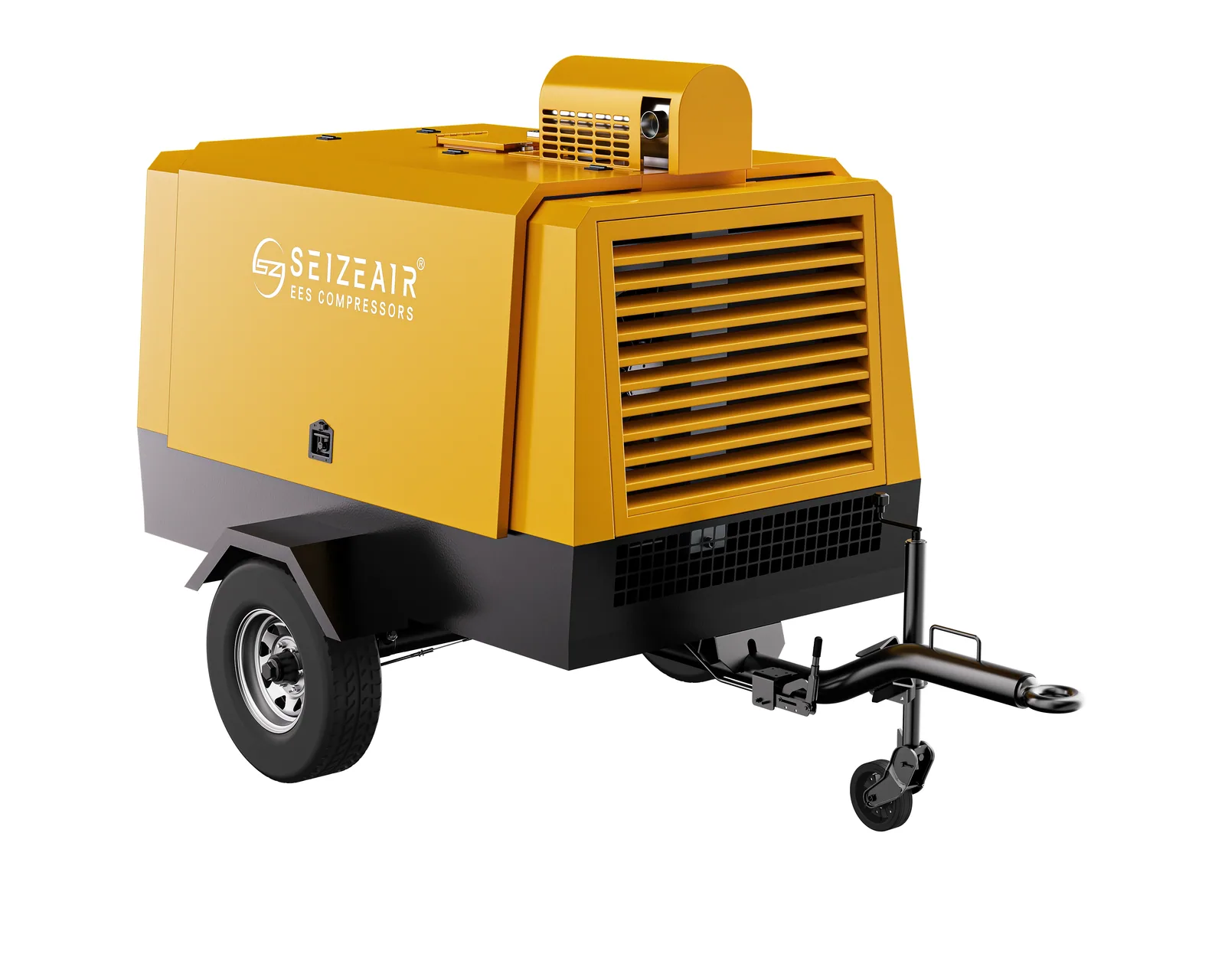
Three mounting families sit under the same word, and they are not interchangeable.
- Towable (trailer) units have an axle, a drawbar, lights and either overrun or electric brakes. They are intended to be moved between sites behind a pickup or light truck, then parked and left running for weeks.
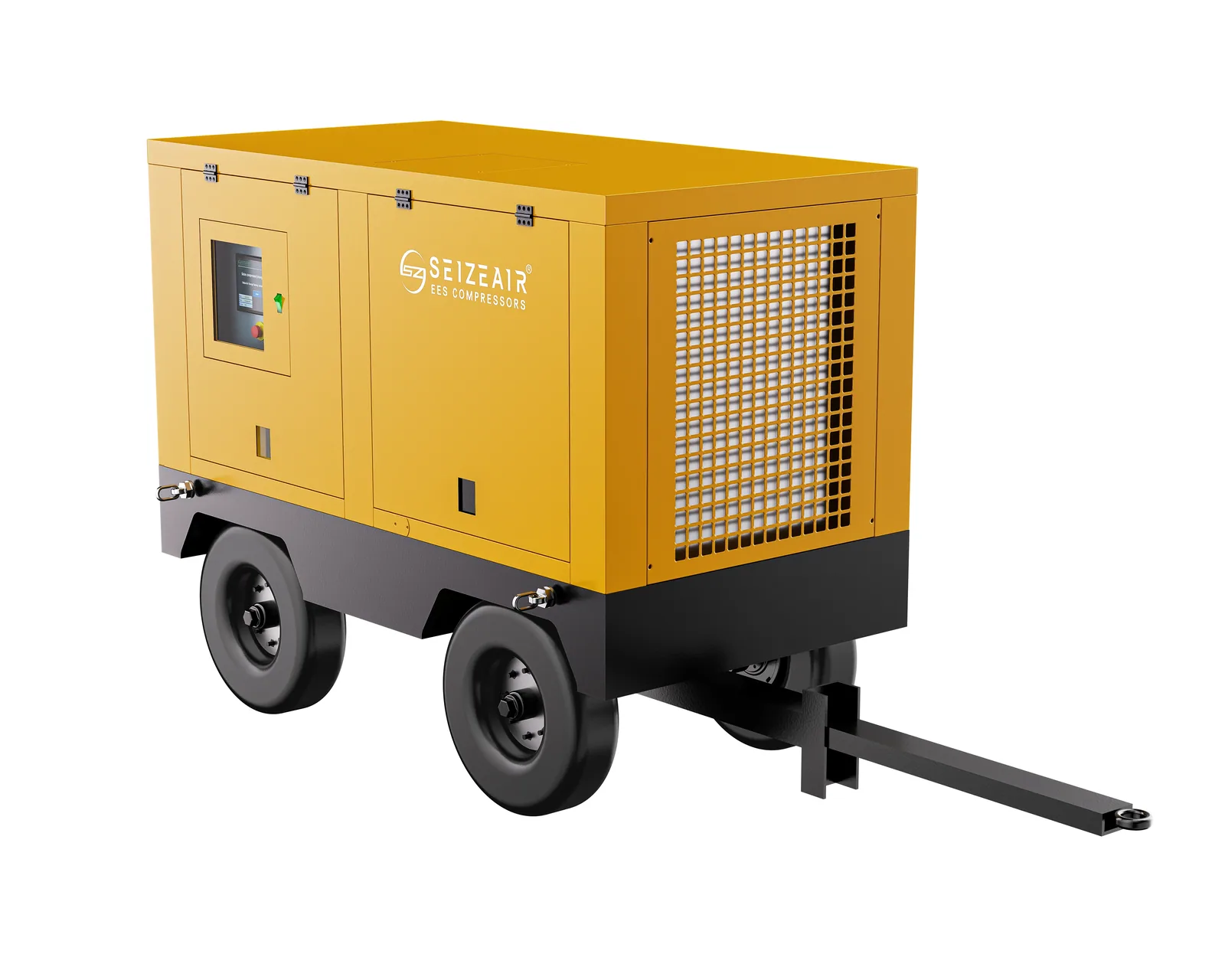
- Skid-mounted units have no axle. They are lifted by forklift pockets or a single-point lifting eye, and they live on a deck, in a container, on a barge, or on the bed of a service truck.
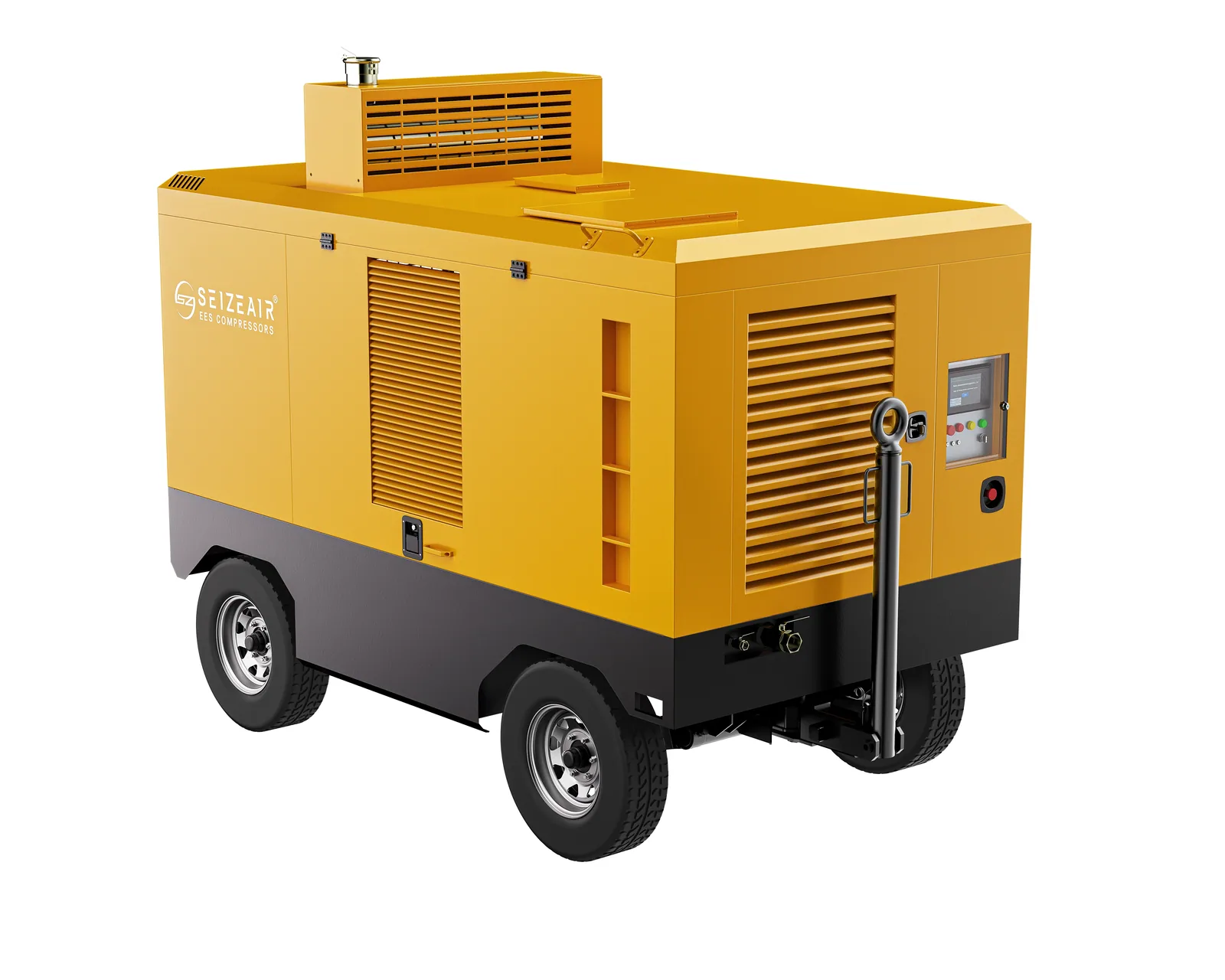
- Truck-mounted or body-mounted units are fixed to the vehicle and driven by a PTO or an auxiliary engine. The compressor never leaves the vehicle; the vehicle is the chassis, the fuel supply and the weather protection.
What portable does not mean: small. A two-stage portable in the highest pressure band weighs more than seven tonnes and delivers more air than a mid-size plant compressor. The word describes logistics, not capacity. When a quotation arrives, the first thing to check is which of the three families it is, because that decides the transport, the lifting plan and — on many sites — whether the unit can be positioned near the point of use at all.
Decision one: flow, and what the flow number really is
Flow is the variable that most often gets a site into trouble, because the number printed on a canopy and the number the tools consume are measured differently.
FAD, displacement and the reference conditions
Serious manufacturers quote free air delivery (FAD) measured to ISO 1217, the international test standard for displacement compressors, at reference conditions of 1 bar absolute, 20 °C and 0 % relative humidity. Displacement — the swept volume of the airend — is a bigger number, and it is not what the tool sees, because some of that volume is lost to internal leakage, re-expansion and, on oil-injected machines, to oil occupying space in the compression chamber.
The practical consequence: two units with identical canopy labels can differ by 10–15 % in real delivered air, and a unit quoted on displacement rather than FAD can look 20 % bigger than it is. Always ask for the FAD figure, the standard it was measured to, and the speed at which it was measured. A portable driven by a diesel engine at 1800–2200 rpm can be rated at more than one speed point; if the datasheet only gives one, ask which.
What our range covers
To give the numbers a frame: our single-stage diesel portables run from 3 to 33 m³/min at 7 to 15 bar, in a weight band from roughly 900 kg for the smallest towable to 4.7 t for the largest. The two-stage range moves up to 12–43 m³/min at 18–35 bar, with units reaching about 7.2 t. The band matters because it maps directly onto site types — 3–8 m³/min covers one or two breakers, 10–20 m³/min covers a small fleet of tools or a shot-blasting pot, and above 25 m³/min you are usually feeding a drilling rig, a pipeline test or a whole work front.
Adding up demand without guessing
The mistake is to add nameplate consumption of every tool on site. Tools are not used simultaneously, and the compressor does not need to cover the arithmetic sum. Do this instead:
- List every air consumer with its rated consumption at its rated pressure.
- Assign each a realistic utilisation factor for the shift — a breaker used 40 % of the time, a blow gun 10 %, a paint gun 25 %.
- Sum the products. That is average demand.
- Add a simultaneity margin for the peak: 20–30 % above average is a common working figure for tool clusters, and the peak, not the average, is what sizes the machine.
- Add an allowance for leakage and for the air you will lose to filtration and hose runs. On an unmaintained site distribution, 20–30 % leakage is common; on a well-kept one, 5–10 %.
A worked example, purely illustrative: three breakers at 1.2 m³/min each, one 0.6 m³/min blow gun, one 0.35 m³/min paint gun. Average with utilisation factors of 0.4, 0.4, 0.4, 0.1, 0.25 comes to about 1.9 m³/min. Add 25 % for peak simultaneity: 2.4 m³/min. Add 15 % for leakage and distribution losses on a temporary hose layout: 2.7 m³/min. A 3 m³/min unit covers this with almost no margin; a 3.5–4 m³/min unit covers it with the margin that stops the breaker stalling when a fourth operator plugs in. Renting or buying at 2.4 m³/min — the peak figure without losses — is the classic under-size.
The measurement-first method for demand that changes through the shift is covered in our guide to calculating compressed air demand; on a portable job the same logic applies with a shorter observation window, usually one full shift with a flow meter on the outlet.
Decision two: pressure, set by the tool and not by habit
Pressure is where money disappears quietly. Most site tools run at 6–7 bar at the inlet. Compressors are offered at 7, 10, 12 and 15 bar in single stage, and from 18 to 35 bar in two stage. Buying the highest pressure band available “for safety” costs flow, fuel and weight, because the same engine and airend moving air to a higher pressure delivers less volume.
The trade-off is physical, not commercial
Compression work rises with pressure ratio. To reach 12 bar instead of 7 bar, the machine does roughly half again as much compression work per cubic metre, and the flow at the same power falls accordingly. A 10 m³/min unit at 7 bar does not become a 10 m³/min unit at 12 bar. If your tools need 7 bar, specifying 12 bar means paying for pressure you throttle away at a regulator, and running the machine at a point in its curve where specific power is worse.
| Band | Typical use | Why this band |
|---|---|---|
| 7 bar | Breakers, drills, blow guns, most hand tools | Matches tool rating with allowance for hose loss |
| 10–12 bar | Shot blasting, some drilling rigs, paint with long runs | Higher nozzle or tool inlet requirement |
| 15 bar | Heavy demolition tools, deep drilling | Single-stage ceiling on flow efficiency |
| 18–35 bar two stage | Water-well and geothermal drilling, pipeline testing | Pressure ratio needs two stages to stay efficient |
Size pressure at the tool inlet, then add the line loss you will actually have. That loss is not theoretical: a 30 m run of 25 mm hose at 4 m³/min can cost close to a bar. The arithmetic is in our article on compressed air pressure drop, and the quick conversions are on the bar to psi page if your tool data is in psi.
A rule of thumb worth knowing when someone proposes raising system pressure to fix a supply problem: at the compressor shaft, every extra bar of discharge pressure costs roughly 7 % more energy for the same delivered mass of air. That is an estimate used across the industry rather than a guarantee for every machine, but it is directionally reliable and it is why “just turn it up” is a bad answer to a pressure complaint at the tool.
Decision three: drive — diesel or electric
The short version: if the site has a reliable power supply and the machine will sit in one place for months, electric is cheaper to run and quieter. If the site moves, has no supply, or needs air within an hour of arriving, diesel wins on availability. The full comparison — fuel price against tariff, emissions rules, cold starting, noise limits near housing — is the subject of its own article, so here only the selection consequence: the drive choice determines the chassis, the maintenance regime and the fuel or cable logistics, and it should be settled before flow and pressure are fixed, not after.
One point that catches people out: electric portables are often specified at a lower pressure band than the diesel unit they replace, because the electric motor’s torque curve does not force the same compromises. Comparing an electric and a diesel unit on canopy flow alone, without checking the pressure at which that flow is quoted, is not a comparison.
Decision four: chassis, weight and the law of the road
Transport rules decide more portable compressor selections than engineering does. Three numbers control it.
Weight
A 4.7 t single-stage unit on a trailer needs a towing vehicle rated for it, a coupling of the right class, and — in most jurisdictions — brakes above a threshold that is usually between 750 kg and 1.5 t. A 7.2 t two-stage unit is in light-truck territory: drawbar load, brake type, lighting and possibly an escort requirement all change. Check the gross vehicle combination weight you are licensed and insured for before choosing the machine, not after it arrives.
Towing speed and road behaviour
Chassis design has a rated towing speed. Units built for site transfer at low speed are not the same as units rated for road speed; a 100 km/h chassis rating, where the local rules permit it, means the axle, brakes, suspension and drawbar are engineered for highway loads, not just for a yard shuffle. If your work is a rotation of sites 80–200 km apart, this rating is worth more than a marginally higher flow figure.
Ground and access
A towable cannot cross a mud site to reach the work face, and no chassis rating changes that. On sites where the air is needed 300 m from the only hard standing, the honest options are skid units lifted into position, a truck-mounted unit, or accepting the pressure loss of a long hose run. Decide which before you fall in love with a trailer.
Decision five: duty — climate, altitude and dust
A portable compressor is rated at reference conditions. Sites are rarely at reference conditions. Three derating factors do most of the damage.
Ambient temperature
Our portables are engineered with cooling capacity designed for 52 °C ambient, which is deliberate: it leaves margin for a machine standing in the sun behind a screen on a 42 °C afternoon, or working inside a container. That margin is not permission to ignore placement. Recirculating hot air under a canopy, or parking the unit with its radiator 300 mm from a wall, defeats a cooling system sized for any climate. On a unit that keeps tripping on high discharge temperature at midday, the first check is airflow, not refrigerant or coolant.
Altitude
Naturally aspirated diesel engines lose power with altitude, and a compressor with a fixed engine speed loses flow with it. A widely used engineering approximation for naturally aspirated engines is about 3 % power loss per 300 m above 1000 m; turbocharged engines lose less but still lose. At 2500 m, a site can easily be 10 % down on rated flow. If your work is at altitude, size for the derated figure or specify a machine with enough margin — do not assume the canopy figure holds.
Dust
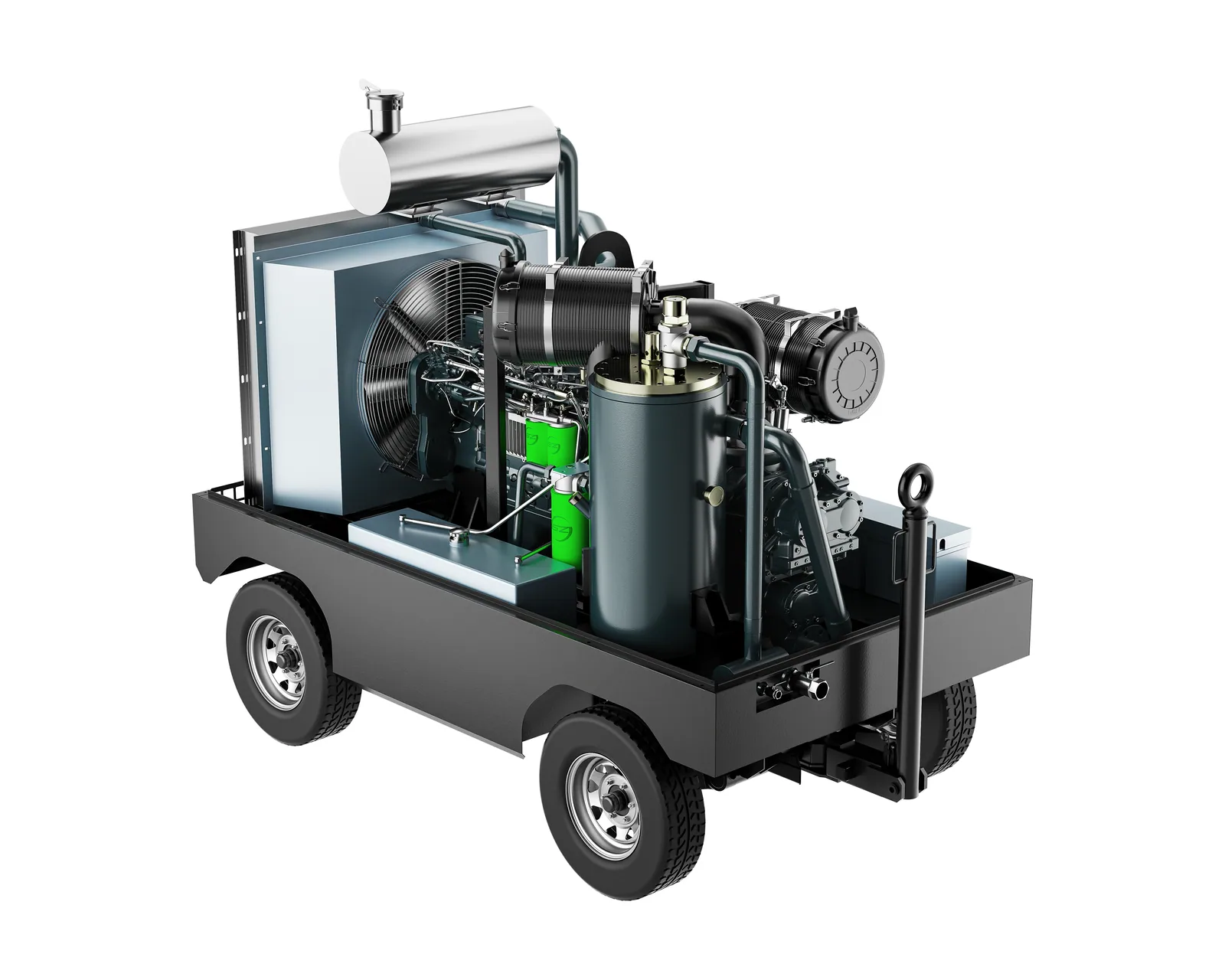
Dust decides intake filtration and service interval more than any other site condition. Our units use a two-stage intake: a primary element that removes about 99 % of incoming dust, with a safety element behind it so that a damaged or badly seated primary does not pass dirt straight to the airend. For desert and quarry work, an optional pre-cleaner performs coarse separation of around 93 % before the air reaches the primary element, which extends element life considerably in the conditions that destroy it fastest.
What this means for selection: on a dusty site, the filtration specification is a purchase criterion, not an accessory. Ask what the pre-separation efficiency is, whether a safety element is fitted, and what the element change interval is at your dust load. A cheaper unit with a single-stage filter will cost more over two years of quarry work than the price difference suggests.
Air quality on site: the part everyone forgets
Portable air is often assumed to be dirty air, and on many sites it is. That is a choice, not a law of physics. What comes out of the compressor depends on what you put after it.
- Condensate is unavoidable. Compressing air to 7 bar concentrates water vapour, and the intercooler and aftercooler drop it out. A portable without a separator and drain sends that water downstream to the tools.
- Oil carry from an oil-injected machine is small but not zero. For paint, sandblasting of surfaces to be coated, or any process where a film of oil ruins the work, either use an oil-free unit or specify coalescing filtration rated to the class you need under ISO 8573-1 filter grades.
- Pressure loss is the price of treatment. Filtration and drying cost pressure, and on a portable the loss lands directly on tool performance because there is no plant-wide pressure margin to absorb it.
Two numbers from our own design data are worth carrying into a selection conversation: the oil separator and the discharge piping each cost roughly 0.03 MPa, and each is worth about 2 % of the machine’s energy consumption. Those losses are engineered in deliberately to keep oil out of the air and to keep the package compact. They are also the reason a portable’s outlet pressure is not the pressure at the tool — budget for both when you decide which pressure band to buy.
If the process needs dry air — painting, powder coating, instrument air, laser cutting on a mobile rig — a refrigerated dryer will hold a pressure dew point around 3 °C and is usually enough. For sub-zero dew points, an adsorption dryer is the only route, and it costs purge air, which on a portable means buying a bigger compressor. Our refrigerated dryer and precision filter ranges are the two components most often added to a portable package for finishing work.
The last thirty metres
Every portable air compressor is judged at the tool, and the tool is usually fed through hose. Three details in that last stretch matter more than the machine’s specification. Hose bore: a 19 mm hose at 4 m³/min loses far more pressure than a 25 mm hose over the same length, and doubling the length roughly doubles the loss. Couplings: every quick-release coupling is a restriction, and a cheap worn set can cost a surprising fraction of a bar across a manifold. Layout: a single long run to a manifold at the work face beats five long runs from the machine, because the trunk carries the flow at low velocity and the branches stay short.
If a portable air compressor “does not keep up” on a site where the arithmetic says it should, measure pressure at the tool inlet before touching the machine. In our experience of site complaints, a meaningful share of them are hose and coupling losses that a machine upgrade cannot fix and a hose change fixes in an afternoon.
Fuel, and the cost per cubic metre nobody calculates
Diesel portables are usually chosen on availability and then judged on fuel. Two design details determine the fuel bill before the site does.
The first is tank size relative to consumption. Our units are specified with fuel tanks sized for more than eight hours of continuous running at rated load, which means a single shift without refuelling and no need for a fuel bowser on a one-shift site. If a candidate machine’s tank gives six hours at rated load, you have bought a refuelling task, not a compressor.
The second is specific fuel consumption at part load. Engines are most efficient near their rated point; a site that needs 40 % of the machine’s capacity most of the day pays a penalty in litres per cubic metre. This is the strongest argument for matching the machine to the demand curve rather than buying one size up “for growth” — on a portable, oversizing is a fuel cost, not just a capital cost.
An illustrative comparison, with all prices stated as assumptions: a 110 kW-class diesel unit delivering 10 m³/min burns roughly 22–25 litres per hour at full load (a typical specific consumption of 0.20–0.23 L/kWh for this engine class). That is 600 m³ of air per hour, so about 0.037–0.042 L/m³. At US$1.20 per litre, that is US$0.045–0.050 per m³. An electric unit of the same shaft power and flow draws about 0.18 kWh/m³, and at US$0.12 per kWh that is US$0.022 per m³. Half the running cost, before anyone mentions maintenance. Substitute your own fuel and tariff figures — the ratio usually holds, and it is why electric units dominate where power is available.
The eight mismatches that show up most often
- Sized on the sum of tool nameplates. Buys 30–50 % too much machine, then runs it at part load where fuel per cubic metre is worst.
- Sized on peak without losses. The opposite error: the unit covers the tools but not the leaks and hose loss, and stalls under a fourth operator.
- Canopy flow compared at different pressures. A 12 bar unit’s flow figure is not comparable with a 7 bar unit’s, and quotations rarely make the difference obvious.
- Highest pressure band bought “for safety”. Pays in flow and fuel, and throttles the excess away at the regulator.
- Trailer chosen for a site that needs a skid. The unit cannot reach the work face; the hose run then eats the pressure margin.
- Cooling margin assumed to cover bad placement. A 52 °C design still needs air; a unit boxed in against a wall will derate or trip.
- Single-stage filtration on a dusty site. Element life collapses and dirt reaches the airend; the saving on the purchase price is spent on elements.
- Air quality specified after the compressor. Paint or blasting work discovers oil carry and water at the worst possible moment, and the retrofit costs both money and a production day.
Checking the machine on delivery
A portable air compressor is a tested package, and the acceptance check is short. Insist on it, and record the numbers.
- Unloaded and loaded running with the service valves closed and open, watching for unstable pressure and unusual noise.
- Discharge temperature at rated load in ambient conditions — should sit well clear of the trip point, not near it.
- Vibration at the frame. We hold whole-machine vibration below 5 mm/s on factory test, which is a useful reference when you compare a new unit against one that has been on site for a year.
- Safety devices: pressure relief valve, high-temperature shutdown, low oil pressure shutdown, emergency stop — each function tested, not just present.
- Instrumentation: pressure gauge, discharge temperature, hour meter, fuel gauge. An hour meter is not a luxury; it is the basis of every service interval.
- Documentation: FAD curve, engine datasheet, filtration specification, wiring and piping diagrams, and the warranty terms in the language your maintenance team reads.
Bearings are worth a specific question on any unit above 20 m³/min, because they set the rebuild interval more than any other component. We specify SKF bearings throughout the airend and drive train; if a supplier cannot tell you what bearings are in theirs, that silence is information.
Maintenance: what the site actually has to do
Portable maintenance splits into two tracks that run at different intervals, and confusing them is the usual cause of a seized airend.
| Track | What is checked | Driven by |
|---|---|---|
| Engine | Oil and filter, fuel filter, coolant, belts, battery | Engine hours, per engine manual |
| Compressor | Intake elements (primary and safety), oil filter, separator, oil condition | Hours and differential pressure |
| Package | Coolers cleaned, drains working, hoses and couplings, safety devices tested | Site condition, more often in dust |
The intake element is the item that most often gets deferred on site, because the machine keeps running when it is dirty — it just runs hotter and pulls more vacuum. A restriction indicator removes the judgement call; if the unit has one, the rule is to act on it, not to wait for the next scheduled service. In desert conditions with a pre-cleaner fitted, element life roughly doubles compared with the same machine without one, which is the practical return on that option.
Where the machine is a long way from a workshop, the service network matters as much as the specification. Our own network covers more than 200 service points, and on portable work the relevant question is not the number — it is whether there is a point within reach of your sites, with the elements and the separator in stock. Ask that question with a map, not a brochure. Details of coverage and response are on our service and support page.
The specification sheet to send a supplier
Give a supplier these twelve lines and the quotation becomes comparable. Leave any of them out and you will be comparing brochures.
- Required FAD in m³/min at the tool, plus the pressure at which it is required.
- Peak demand and the simultaneity assumption behind it.
- Site altitude and maximum ambient temperature.
- Dust load: quarry, desert, indoor, clean.
- Mounting: towable, skid, or vehicle-mounted.
- Towing speed requirement and towing vehicle rating.
- Drive: diesel or electric, and supply voltage if electric.
- Air quality class required, and the process that sets it.
- Duty pattern: hours per shift, shifts per week, expected load factor.
- Fuel or cable logistics on site.
- Ambient noise limit if working near housing.
- Service distance from the nearest support point.
Two conversions are worth having on hand when tool data arrives in mixed units: cfm to m³/min for flow, and bar to psi for pressure. Most of the confusion in portable selection is unit confusion wearing an engineering costume.
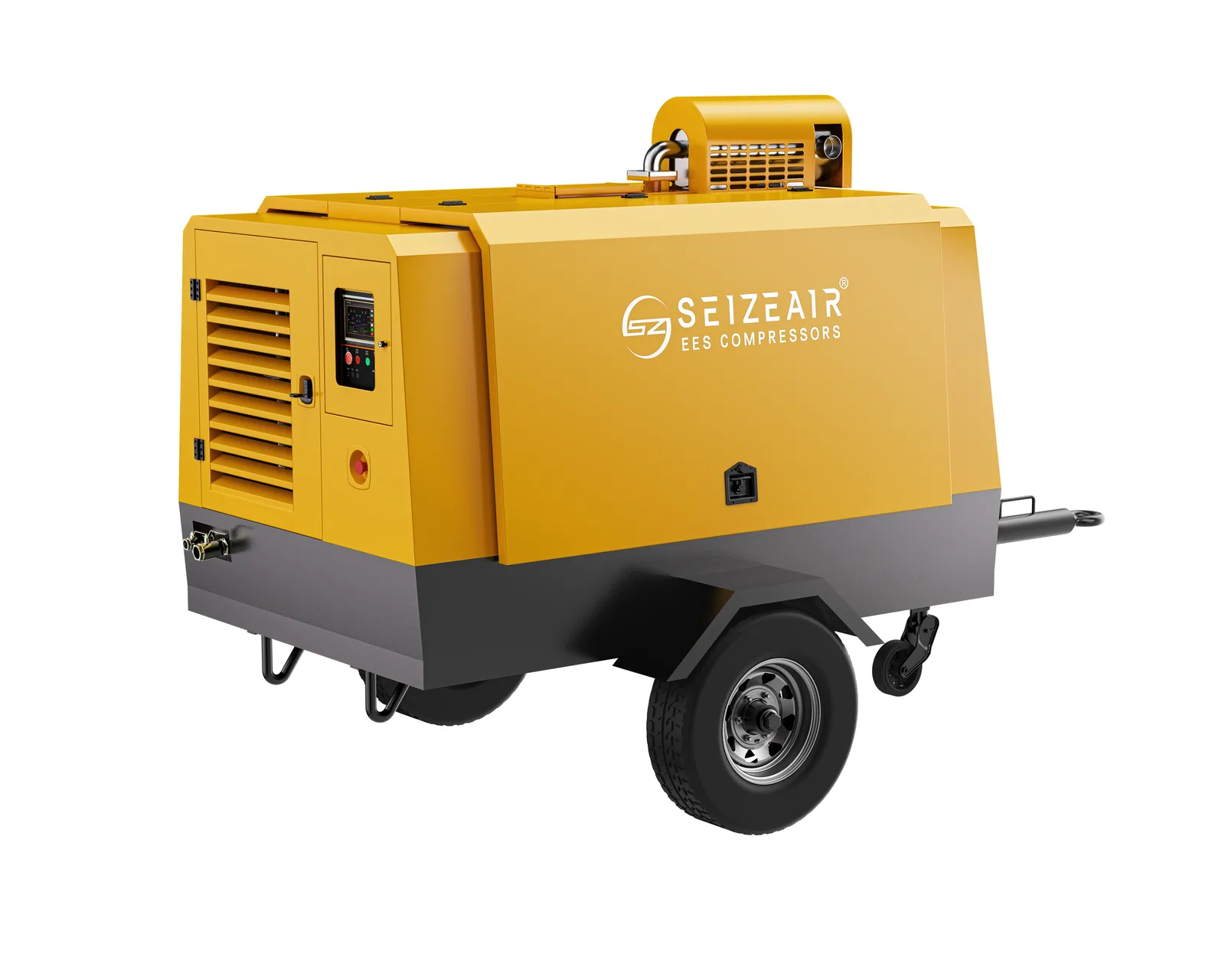
Where the decision lands
Five variables, in this order: flow at the tool including losses, pressure at the tool including line loss, drive, chassis and weight against your transport reality, then duty conditions — heat, altitude, dust — that derate everything above. Air quality and maintenance come after, and both are cheaper to specify than to retrofit.
What separates a good portable from a cheap one is rarely visible on the canopy: how the cooling is sized, what the filtration actually removes, whether the bearings are named, whether the fuel tank covers a shift, and whether the chassis is rated for the road it will travel. Those five answers, plus a FAD figure you can trace to ISO 1217 test conditions, are enough to make a decision that survives contact with the site. As a manufacturer we publish ours, and we are happy to be measured against them: start from our manufacturing and certification overview, or look at how these units perform on customer sites in our customer case section.