



 English
 Russia
 France
 Spain
 Arab

“Which filter do I need?” is the question most buyers start with, and it is the one question that cannot be answered on its own. A filter grade means nothing until you know what class of air the application demands, where in the system the filter sits, and what you are willing to pay in pressure drop to get it. This guide works through all three, in that order.
This guide is about compressed air filter grades in the practical sense: which stage does what, how the stages map onto ISO 8573-1 classes, and where the money is actually spent.
The reason the order matters is simple. A plant that buys the highest grade available everywhere ends up paying for filtration it does not need, in energy, every hour of every year. A plant that buys by micron number alone ends up with clean particles and oily air, because particle size is only one of three contamination types and the cheapest element in the catalogue does nothing about the other two. Both mistakes are common, and both are avoidable once the grading logic is clear.
What follows is written for the person specifying the equipment — the plant engineer, the maintenance lead, or the buyer comparing two quotations that both say “ISO 8573-1 compliant” without saying which class.
What a filter grade actually specifies
A compressed air filter is rated by what it removes and how well, and those are two different axes. Most confusion in procurement comes from reading only one of them.
The first axis: what it removes
Compressed air carries three broad families of contaminant, and no single element handles all three:
- Solid particles — rust, scale, pipe debris, dust pulled in at the compressor intake, desiccant fines from a regenerative dryer.
- Liquid aerosols and water — condensed water and, in oil-lubricated machines, oil carried over as a fine mist. This is the fraction that coalescing filters are built to catch.
- Oil vapour and odour — gaseous hydrocarbon, which passes straight through a coalescing element because it is not a droplet. Removing it requires adsorption, conventionally activated carbon.
That third item is where specifications go wrong most often. A buyer orders a 0.01 µm coalescing filter, assumes it delivers oil-free air, and discovers on commissioning that the air still smells. The element is doing exactly what it was designed to do; the specification asked the wrong question.
The second axis: how well it removes it
Performance is expressed differently for each family. Particulate filters are generally rated by a nominal or absolute micron figure. Coalescing filters are rated by the residual oil content they leave downstream, in milligrams per cubic metre, measured under a defined test procedure — ISO 12500 is the test method most manufacturers cite for this. Activated carbon elements are rated by residual oil content again, but an order of magnitude lower, and critically by service life, because carbon is consumed rather than cleaned.
This is why two datasheets that both claim “0.01 mg/m³” are not automatically equivalent. One may be quoting a result at the start of element life under ideal inlet conditions, the other at the end of a defined test duration with a realistic oil challenge. When comparing quotes, ask which test method and which point in the life cycle the figure represents.
ISO 8573-1: the class system in plain terms
ISO 8573-1 is the standard that turns “clean air” into a number. It defines purity classes for the same three contaminant families, and a proper specification always states all three — for example, a common industrial requirement is written as particles class 2, water class 4, oil class 1. Note that the three numbers are independent: class 1 for oil says nothing about water.
The structure is a descending scale, where a lower class number means cleaner air, and Class 0 sits outside the numbered scale as a class specified by the user or the equipment manufacturer, stricter than Class 1 and defined by an agreed test method.
The thresholds most widely cited in the industry for each family run approximately as follows — oil as total oil content in mg/m³, water as pressure dew point in °C:
- Oil (liquid, aerosol and vapour together): Class 1 ≤ 0.01 mg/m³, Class 2 ≤ 0.1 mg/m³, Class 3 ≤ 1 mg/m³, Class 4 ≤ 5 mg/m³.
- Water, expressed as pressure dew point: Class 1 ≤ −70 °C, Class 2 ≤ −40 °C, Class 3 ≤ −20 °C, Class 4 ≤ +3 °C, Class 5 ≤ +7 °C, Class 6 ≤ +10 °C.
- Particles: defined by particle size band and count or mass concentration, with Class 1 the strictest numbered band.
Two honest caveats. First, these are the values commonly published by equipment manufacturers and industry references; the authoritative figures are in the current edition of the standard itself, and if a contract depends on them, cite the standard, not this article. Second, water class is in practice delivered by the dryer, not by a filter — a coalescing filter removes liquid water that has already condensed, but it will not lower a dew point. Confusing those two mechanisms is the single most expensive specification error in this area, because it leads people to buy more filtration to solve a drying problem.
If you want the background on how the standard is applied across different industries, the earlier article on compressed air quality standards covers that ground; this article picks up at the point where you already know your class and now have to choose hardware.
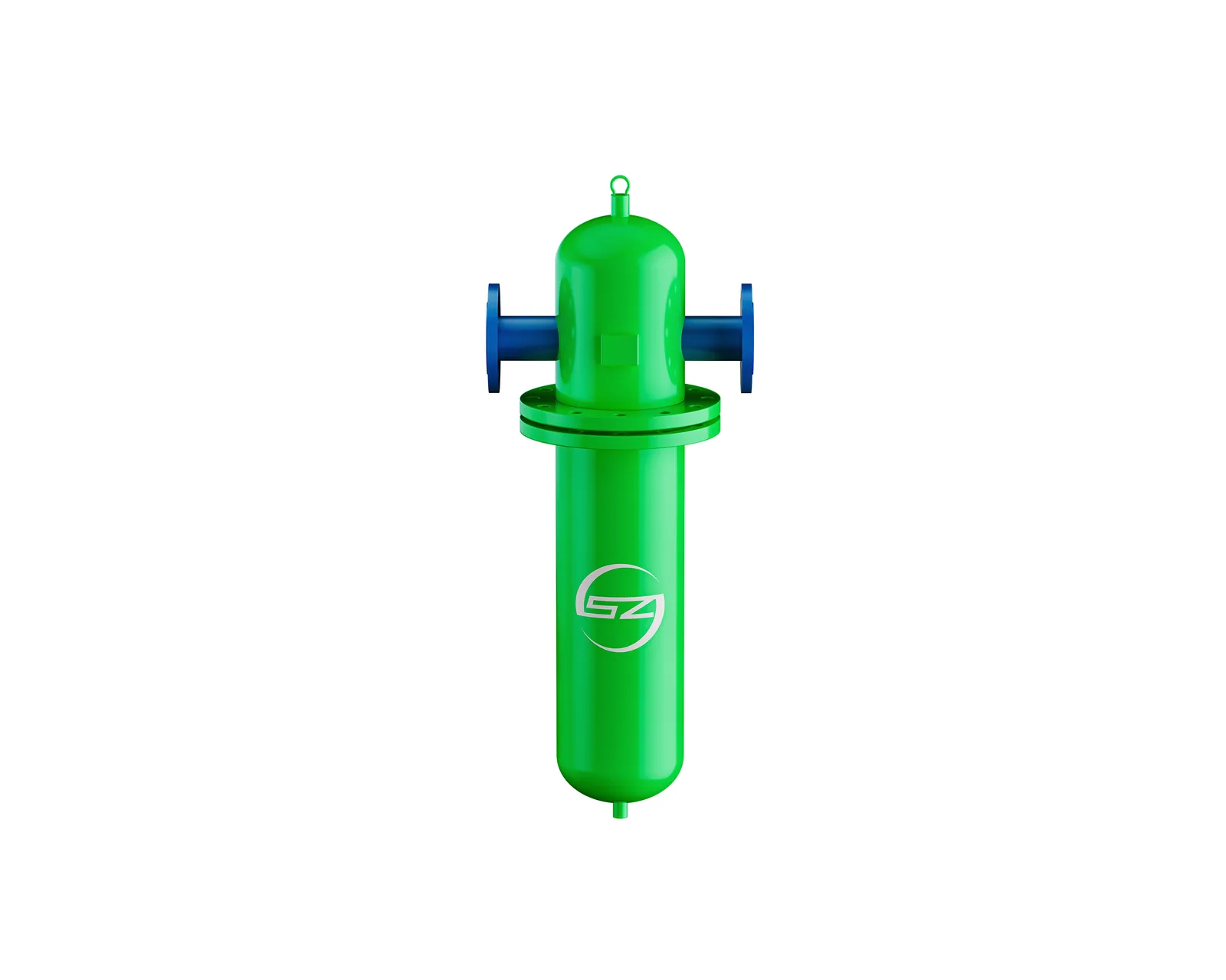
The four functional grades, and what each one is for
Read compressed air filter grades as a functional ladder rather than a brand catalogue, and the rest of the specification follows.
Manufacturers use their own naming conventions — letters, numbers, series names — and those names are not interchangeable between brands. What is comparable is function. In practice, a treatment train uses up to four functional stages, and the art of specification is deciding how many you actually need.
Stage 1 — coarse particulate and bulk liquid
Usually rated in the region of a few microns, this stage exists to protect everything downstream. It catches pipe scale, rust and the bulk of condensed water, and it is cheap. Its real job is to stop the expensive elements behind it from being blinded in three months by debris that has nothing to do with filtration performance. Skipping it to save a housing is a false economy that shows up as premature replacement of the finer stages.
Stage 2 — general-purpose coalescing
The workhorse of most systems. A coalescing element forces fine droplets to merge into larger ones and drain away rather than passing through. Typical residual oil figures quoted at this grade are in the tenths of a milligram per cubic metre range, which is consistent with oil class 2 or better depending on inlet conditions. This is the stage that makes the difference between air that fouls pneumatic tools and air that does not.
Stage 3 — high-efficiency coalescing
Tighter media, finer retained oil aerosol, and a correspondingly higher pressure drop. Residual oil figures quoted for this grade are commonly an order of magnitude below the general-purpose stage, entering the range associated with oil class 1. It is justified where the downstream process is sensitive — paint finishing, food contact, instrumentation air — and it is not justified where the air drives a wrench.
Stage 4 — oil vapour removal
Activated carbon adsorption, and the only stage in this list that addresses vapour and odour rather than droplets. It is always the last element in the train, always downstream of the coalescing stages, and always consumable: carbon saturates. It also has a temperature and oil-loading limit — put wet, oily air into a carbon element and you will consume it in a fraction of its rated life.
There is one more option worth naming so that it is not confused with the above: a sterile or microbiological filter, used in food, beverage and pharmaceutical applications where the concern is viable organisms rather than oil. It is a different failure mode and a different validation regime; if your process requires it, the specification should say so explicitly rather than assuming a high oil class covers it.
What a grade label does not tell you
Compressed air filter grades are not interchangeable between manufacturers, which is the practical reason two quotations for “the same grade” can perform differently on site. The grade describes function; the datasheet describes performance, and only the datasheet carries the conditions. When you read one, five items deserve attention beyond the headline number.
The naming convention is proprietary. One manufacturer’s mid-range coalescing element and another’s may carry different letters, different series numbers, and different claimed figures while serving the same slot in the train. Compare function and measured residual, never the label.
The test conditions define the number. Residual oil figures depend on inlet oil concentration, flow rate, temperature and whether the reading is taken at the start or the end of a defined test. A figure quoted at low inlet loading will not survive in a plant with heavy carryover. Ask which inlet challenge the number assumes.
Temperature rating is a real limit. Media and housing materials have maximum operating temperatures, and the air leaving some compressors and dryers is hotter than buyers assume. An element operated above its rating does not fail loudly; it degrades and passes what it should retain.
Housing size governs pressure drop. The same media in a larger housing gives lower differential pressure and longer life. Where two quotes differ noticeably in price for an identical stated grade, the housing is usually where the difference is.
Documentation may be part of the requirement. In regulated industries the question is not only what the element achieves, but what evidence exists that it achieves it — material declarations, food-contact statements, test certificates. If your process is audited, request these at enquiry stage rather than at commissioning, because retrofitting documentation is slower than retrofitting hardware.
Matching grade to application
Below is a working map from application to the functional stages that are normally justified. It is a starting point for a specification, not a substitute for the process requirement — where a customer standard or a product contact rule exists, that document wins.
| Application | Stages normally justified | What drives the requirement |
|---|---|---|
| General workshop air, pneumatic tools, cylinder actuation | Coarse particulate + general coalescing | Equipment life and drain cleanliness; oil vapour is not usually a concern |
| Paint spraying and finishing | Coarse + high-efficiency coalescing + carbon | Silicone and oil cause fish-eye and adhesion defects; the defect cost dwarfs the filter cost |
| Food and beverage, indirect contact | Coarse + high-efficiency coalescing + carbon | Contamination risk and audit trail; documentation of the air class matters as much as the hardware |
| Food and beverage, direct product contact | Above plus sterile filtration and validation | Microbiological control, not just oil; requires a defined validation and monitoring regime |
| Electronics and precision assembly | Coarse + high-efficiency coalescing, carbon where odour matters | Particles and oil on sensitive surfaces and optical paths |
| Instrumentation and control air | Coarse + general or high-efficiency coalescing, dew point set separately by dryer | Valve and actuator reliability; here the water class is usually the binding constraint |
| Pharmaceutical and medical | Per process validation; often oil-free compressor plus carbon plus sterile | Regulated environment; specification follows the validation protocol, not a catalogue |
Notice that only three of the seven rows justify carbon, and only two justify sterile filtration. Over-specifying those two stages across a whole plant is the most common form of overspend in treatment equipment, and it is rarely questioned because nobody measures the pressure drop it costs.
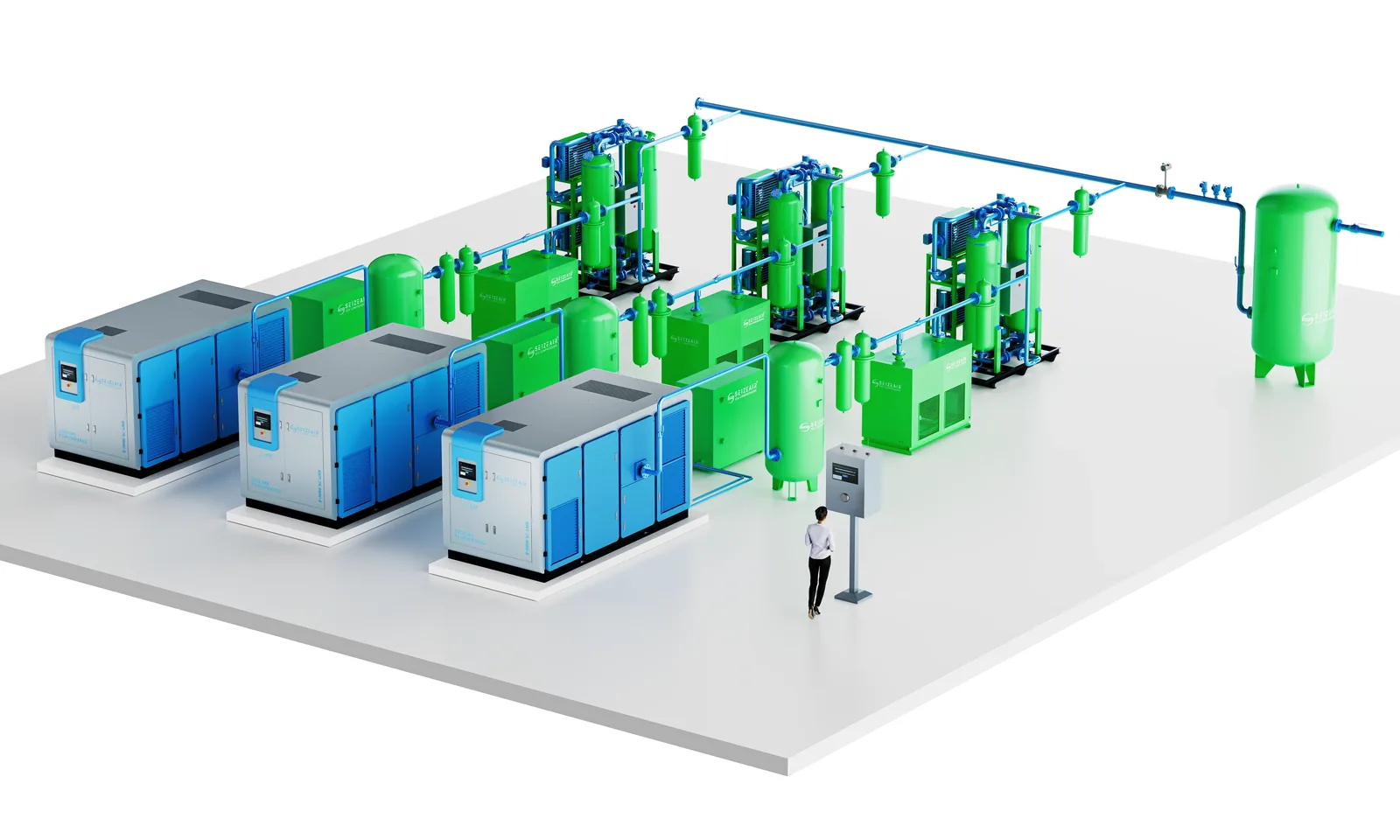
Where the filter goes: order matters more than grade
A correctly graded element installed in the wrong place delivers worse air than a mediocre element installed correctly. Three rules cover almost every case.
Rule 1 — coarse before fine, always
The coarse stage protects the fine stage. Reversing them does not just shorten element life; it can blind the coalescing media with debris in weeks and produce a pressure drop nobody attributes to the filter.
Rule 2 — coalescing before carbon, always
Carbon is an adsorbent with finite capacity. Every droplet of liquid oil that reaches it consumes capacity that should have been spent on vapour. A carbon element installed without a coalescing stage ahead of it is a consumable with a very short and entirely predictable life.
Rule 3 — decide the dryer’s position deliberately
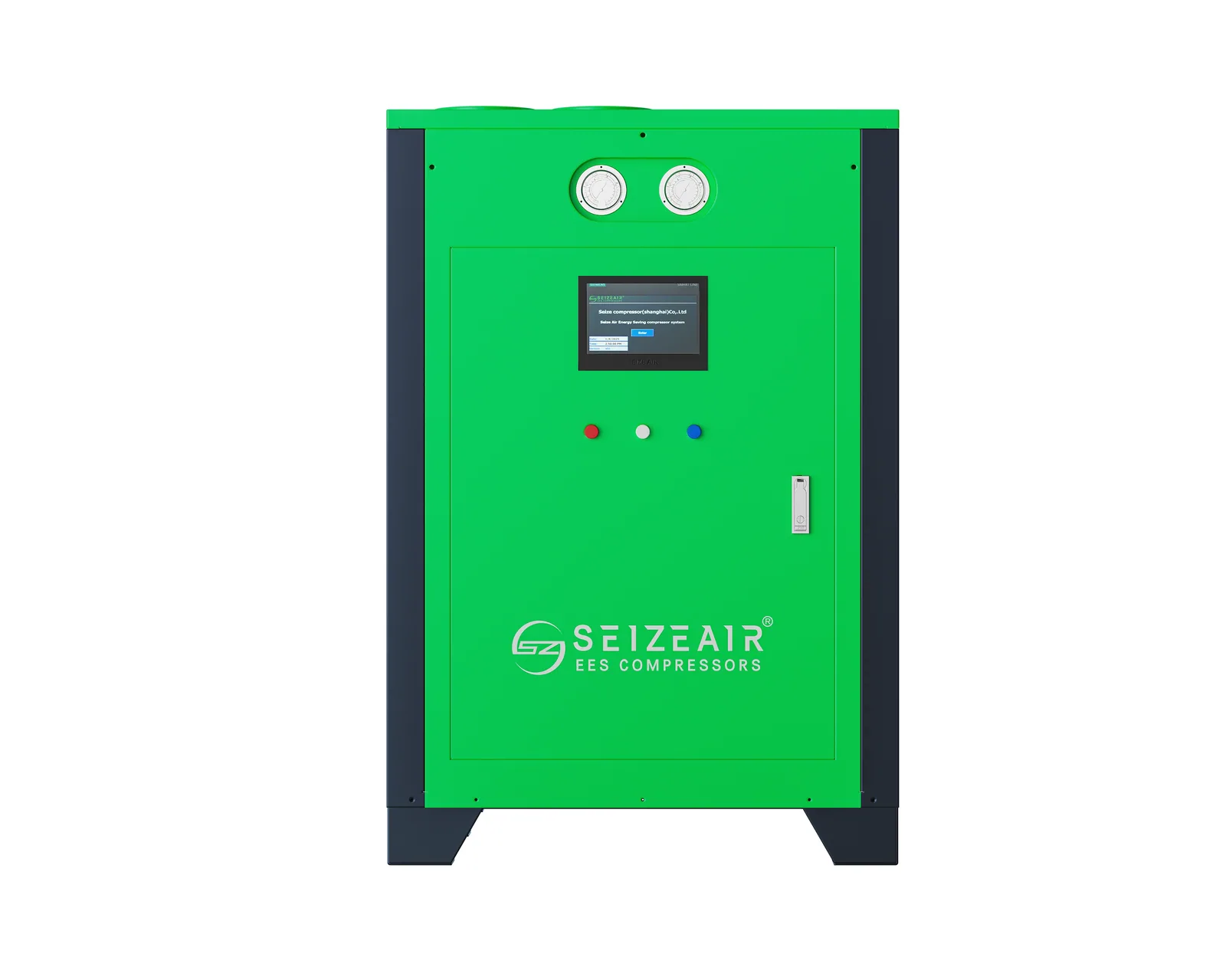
There are two defensible layouts and they behave differently. A refrigerated dryer ahead of the coalescing filter removes bulk water first, so the filter handles less liquid load — but the air leaving the dryer is cold, and any further cooling downstream can produce more condensate. A coalescing filter ahead of the dryer protects the dryer’s heat exchanger from oil fouling, which is the more common reason to put it there in oil-lubricated systems. Which one you choose depends on whether your binding constraint is oil on the dryer or water on the filter, and it should be stated in the design rather than left to the installer.
One point that is worth stating plainly because it comes up in every commissioning meeting: filters do not dry air. If the requirement is a pressure dew point, that is a dryer specification. If the requirement is oil content, that is a filter specification. Our earlier piece on compressed air pressure drop covers the interaction between treatment components and system pressure in more detail, which is the next thing to consider.
Pressure drop: the cost of over-filtering
Every element in the train takes pressure, and every bar of pressure you generate and then lose across a filter is energy you paid for and did not use. New elements start at a clean differential pressure, typically a fraction of a bar, and rise as they load. The question is not whether the filter costs pressure — it does — but when it should be changed.
The trap is replacing on a fixed calendar. A filter on a lightly loaded line may run two years without approaching its change-out differential, while the same model on a dirty line may be spent in six months. Calendars and element costs are easy to budget; the energy wasted by running a loaded element to a date on a spreadsheet is invisible, and it is usually larger than the element itself.
The correct trigger is measured differential pressure across the housing. Two practical points make this work in a real plant: fit a differential pressure indicator on the housings that matter, rather than relying on a general system gauge, and record the clean reading at commissioning so there is a baseline. Without a baseline, the first reading six months later tells you nothing.
A second, less discussed cost: sizing. An undersized housing produces a high pressure drop when new and gets worse from there. If a quotation is noticeably cheaper than a competitor’s for the same stated grade, check the housing size and the rated flow before accepting it — the grade may be identical, and the pressure drop may not be.
Drains: the failure nobody budgets for
A coalescing filter collects liquid. If that liquid is not removed, the element floods, the media loses its ability to coalesce, and the collected oil is re-entrained into the downstream air — the filter becomes a source of contamination rather than a barrier to it. This failure mode is entirely silent. The pressure gauge looks normal. The element has not reached its change interval. The air downstream is worse than if no filter were fitted.
Three drain approaches exist, and the choice matters more than most buyers expect:
- Manual drain — cheapest, and dependent on someone remembering. Acceptable only where the load is genuinely small and the route is walked daily.
- Float drain — mechanical, no power, opens when liquid accumulates. Reliable in most service; a failed float usually shows up as either continuous air loss or a flooded housing.
- Electronic timed or level-sensed drain — highest capital cost, best control, and the only option that logs or alarms. Worth it on a critical line or a remote location.
Whichever is chosen, an air-loss drain wastes compressed air every time it opens, while a failed-closed drain floods the housing. Both are maintenance items, and both belong in the periodic route — a drain that has not been checked in a year is a coin toss.
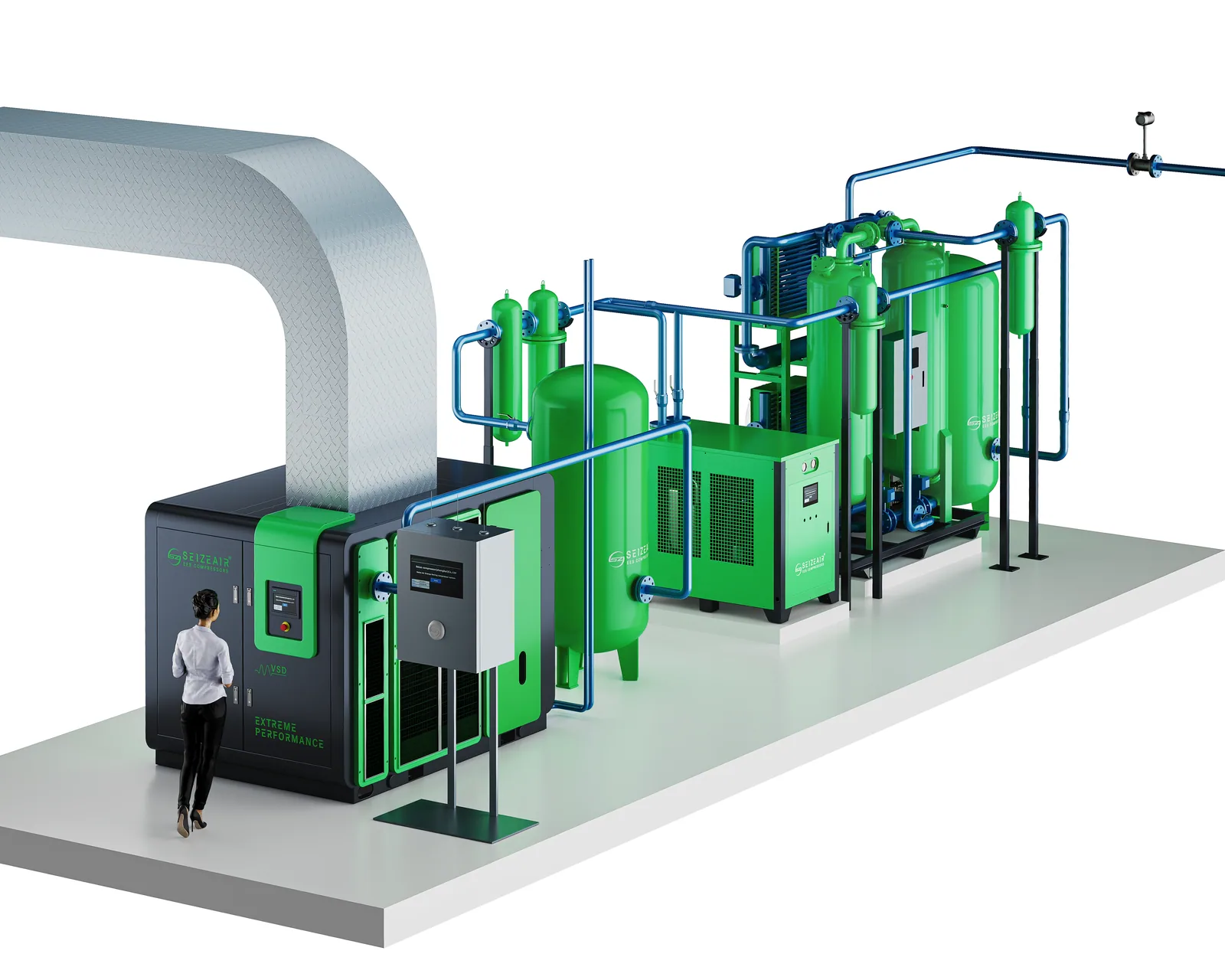
How the compressor type changes the train
The same specification produces two very different filter requirements depending on what generates the air, and this is where a filter decision should actually begin.
An oil-injected screw compressor puts a measurable oil carryover into the air by design — that is how the machine is lubricated and sealed. The oil separation system removes the great majority of it, but the residual aerosol still has to be dealt with downstream, which means coalescing filtration is not optional and carbon is a live question wherever odour or product contact matters. If you want to understand what happens inside the machine before the air even reaches the filter, the article on oil-gas separation in oil-injected screw compressors explains the mechanism.
An oil-free machine starts from a completely different place: there is no lubricating oil in the compression chamber, so there is no oil aerosol to remove in the first place. Two consequences follow, and both are frequently misunderstood. First, the filtration train is simpler and cheaper for the same delivered oil class. Second, and this catches people out, “oil-free compression” does not guarantee oil-free air at the point of use — the intake air in a plant that has oil aerosols, solvent vapours or engine exhaust in it will carry those contaminants straight through the compressor. Specifying oil-free compression without considering intake air quality is specifying a machine and hoping for a system.
That distinction is the subject of the comparison of oil-free and oil-lubricated compressors, and the water-lubricated variant adds its own considerations, covered in the comparison of oil-free and water-lubricated screw compressors. Where certification matters, the ISO 8573-1 Class 0 certification note explains what a Class 0 claim actually rests on — and why the test method has to be named alongside it.
The practical takeaway for specification: state the compressor type and the required delivered class together. A filter train sized for an oil-injected machine is over-specified for an oil-free one, and a train copied from an oil-free installation onto an oil-injected machine will fail its oil class within weeks.
Element life: what actually ends it
An element reaches end of life for one of four reasons, and only the first is the one most people expect:
- Loading. It has captured enough contaminant to raise differential pressure to the change point. This is the intended failure and the only one a pressure gauge reveals.
- Flooding. A drain failed and the media is saturated with liquid. Pressure drop may not rise much, but performance collapses and re-entrainment begins.
- Carbon exhaustion. For vapour stages only, the media is consumed. There is no pressure drop signal — the element looks fine and passes air while passing odour too.
- Media damage. A pressure surge, a chemical incompatibility, or exceeding the temperature rating destroys the media structure. The filter then passes what it should retain, and no routine check will catch it.
Carbon exhaustion deserves emphasis because it is the one failure with no instrument to detect it. The only defensible control is a replacement interval based on operating hours and inlet oil load, with the interval set from the manufacturer’s data rather than from a general rule of thumb, plus a periodic odour or oil-content check downstream for critical applications.
Verifying the class you specified
A specification on paper and a class at the point of use are two different things, and the gap between them is where most disappointment lives. Verification means sampling the air where it is used, not at the compressor outlet, and testing against the same standard you specified.
Three findings are common enough to be worth expecting. Particle counts measured at the point of use are frequently worse than at the outlet, because the distribution system contributes its own rust and scale — a fact about the pipework, not the filter. Oil content readings can be fine at the outlet and elevated downstream of a regulator or a lubricated tool, where oil is introduced deliberately. And dew point problems usually trace back to the dryer, or to ambient conditions the dryer was never sized for, rather than to the filters.
Testing is not cheap, but for a critical application it is far cheaper than discovering the problem through rejected product. For less critical lines, a periodic check is enough — the point is to test at least once, so that future readings have a baseline.
Specification checklist
Before sending an enquiry, the following should be settled. Every item on this list is a question a supplier cannot answer for you:
- Required class, stated in full — particles, water and oil, each as a number, not “ISO 8573-1 compliant”.
- Compressor type — oil-injected, oil-free or water-lubricated, because it sets the inlet challenge.
- Intake air conditions — dust, solvent vapour, humidity extremes, and anything corrosive nearby.
- Actual flow and pressure — including peak demand, not just average, since housings are sized for the worst case.
- Dryer type and position — stated explicitly, with the dew point requirement assigned to the dryer rather than to the filter.
- Drain type on each housing — and who checks it.
- Differential pressure indication — fitted, with the clean reading recorded at commissioning.
- Change trigger — measured differential pressure, plus a fixed interval for carbon stages.
- Acceptable pressure drop for the whole train — a number, so that a cheap quotation that doubles it can be identified.
- Verification plan — where the air will be sampled, and by which method.
Common questions
Is a finer micron rating always better?
No. Finer media means higher pressure drop and, generally, shorter life. The right grade is the coarsest one that meets the required class with margin. Specifying the finest element available adds energy cost every hour and does not improve product quality beyond the point where the class is already met.
Do I need carbon filtration if I have an oil-free compressor?
Usually not for compressor oil, because there is none to remove. But if the intake air carries oil aerosol or solvent vapour from elsewhere in the plant, carbon may still be justified. The question is about the air entering the compressor, not the machine’s lubrication method.
Can one filter deliver several classes at once?
Not across contaminant families. A single element has one media and one mechanism. Delivering a particle class and an oil class together usually requires two stages in one train, and delivering a vapour class requires carbon in addition.
Why does my air smell even after a new filter?
Almost always because the requirement was a vapour problem and the installed element is a coalescing one. Droplets are being removed correctly; vapour passes through. Adding an activated carbon stage downstream of the coalescing element is the standard fix.
How often should elements really be changed?
On differential pressure for particulate and coalescing stages, and on hours plus inlet load for carbon. A calendar interval is a fallback for sites with no instrumentation, not a specification.
Where this leaves the specification
Choosing a filter grade is not a product decision, it is a system decision. The class comes from the application, the stages come from the class, the position comes from the mechanism, and the cost is paid in pressure drop for the life of the plant. Working through it in that order takes longer than picking a model from a catalogue, and it is the difference between a treatment train that quietly protects the process and one that quietly consumes energy while delivering air nobody has verified.
Once compressed air filter grades are settled this way, the remaining decisions are about size, drains and verification — not about the grade.
If you are comparing quotations, the most useful thing to ask both suppliers is not the grade but the pressure drop of the complete train at your flow, and the differential pressure at which they recommend change-out. Those two numbers separate a serious specification from a cheap one, and they are the ones that show up in your electricity bill.