



 English
 Russia
 France
 Spain
 Arab

Every serious air compressor purchase ends up being two purchases at once: the machine, and the organization that stands behind it. Buyers usually spend their energy comparing the machine — power, pressure, flow, price — and then discover, one or two years later, that the real differences between suppliers show up somewhere else entirely: in how honestly the performance numbers were measured, how fast a spare part arrives, and whether the service technician who shows up can actually read the machine he is servicing. A structured air compressor supplier evaluation exists to surface those differences before the contract is signed, not after the first breakdown.
This article is written for plant managers and purchasing teams buying screw compressors for industrial use — whether from a local distributor, a direct factory, or through an import channel. The method is the same in all three cases. What changes is how much of the evidence you can see with your own eyes.
Why the supplier matters more for compressors than for most purchases
Three characteristics of compressed air equipment make the buying decision unusual, and each of them shifts weight from the machine to the supplier.
First, the purchase price is a minority of the lifetime cost. Industry references such as the US Department of Energy’s compressed air program have repeated for years that electricity dominates the cost of owning and operating an air compressor over its life — commonly around three quarters, with the initial purchase representing only about 12%. This is precisely why a rigorous TCO comparison beats a quotation comparison; our article on what you actually pay over 10 years walks through that arithmetic in detail. But the TCO logic also has a supplier dimension: the electricity figure in any calculation comes from the supplier’s own specific power claims. If those numbers are optimistic, every downstream calculation inherits the error.
Second, the machine depends on consumables and parts for 15 to 20 years. Filters, oil, separators, gaskets, valves and eventually the airend itself must be available long after the salesperson has moved on. For a machine built in another country, the question “who stocks the spares, and at what price?” is not a detail — it is half the contract.
Third, downtime is expensive in ways the invoice never shows. When a production line stops because the air system is down, the cost per hour is set by your product, not by the compressor’s price. The supplier’s service network — its response time, its diagnostic capability, its local stock — is the insurance policy. An insurance policy nobody evaluated is not insurance.
Layer 1: Verify the company before the machine
The first layer of any air compressor supplier evaluation has nothing to do with compressors. It establishes who you are actually dealing with.
Manufacturer, assembler or trading company?
The compressed air market has all three, and they are not equivalent. A manufacturer designs and produces the core components (or at least the airend and the complete machine assembly) in its own plant. An assembler buys major components — airend, motor, controller — from third parties and packages them into a machine. A trading company sells machines it does not build and often cannot service directly.
None of these is automatically wrong. Assemblers can build excellent machines from first-tier components, and trading companies sometimes offer better local service than distant factories. What matters is that you know which one you are talking to, because it changes what the supplier can honestly promise:
- Only a manufacturer can commit to long-term spare parts availability for its own components, because only it controls the production drawings and the supply chain behind them.
- An assembler’s long-term parts story is only as strong as its component suppliers’ commitments — ask which components are third-party and how their availability is secured.
- A trading company can quote anything; its real deliverable is the service relationship, so evaluate it mostly on the service layer described later in this article.
The fastest verification is a factory visit or, if travel is not feasible, a live video walkthrough. Ask to see the production line during normal working hours, not a showroom. A recorded marketing video is not verification — anyone can record a video.
Track record and export experience
Two questions sort most suppliers quickly. How long has the company built this category of machine — not existed, but built it? And does it have reference installations in your industry and, if you are importing, in your region? A supplier with a decade of oil-free screw production and installed machines in tropical climates has already solved problems that a newcomer will solve on your installation, at your expense.
Export experience specifically shows up in documentation quality: machines shipped across borders need proper CE documentation, correct voltage and frequency variants, seaworthy packing, and manuals that actually match the delivered machine. A supplier who exports routinely produces this package without being chased; a supplier who exports occasionally will improvise on your shipment.
Layer 2: Interrogate the performance numbers
This is the layer where supplier evaluations earn their keep, because performance claims are where the widest honest-versus-optimistic gaps appear.
Specific power and how it was measured
The honest metric for compressor efficiency is specific power: kilowatts consumed per unit of air delivered, typically expressed in kW/(m³/min) or kW per 100 cfm. It is the number that should drive your energy calculations, and it is exactly the number most susceptible to being quoted under favorable assumptions. Two questions separate a serious supplier from an optimistic one:
- Under which standard was it measured? Flow measurement for displacement compressors is standardized in ISO 1217, which defines the reference inlet conditions and the accepted measurement methods. A supplier who can name the standard, the annex used, and the test conditions is speaking a verifiable language. A supplier who answers “tested in our lab” without naming the method is asking you to trust a number you cannot reproduce.
- At which package conditions? A figure measured without intake filtration, dryer or full enclosure losses describes a bare machine, not the package you will receive. Ask explicitly whether the quoted specific power is for the complete package under your site conditions.
The most reliable suppliers publish tested package figures and can produce the test report for the specific model on request. If a supplier hesitates to provide a test report for the machine you are buying, treat every efficiency claim in the offer as unverified — and re-run your payback calculation with a conservative margin.
Certified air quality claims
For oil-free and oil-sensitive applications, air quality certification is the second verifiable number. The ISO 8573-1 standard defines purity classes for particles, water and oil, and a genuine Class 0 certificate declares the actual residual oil value and the measurement method — not just the words “Class 0”. During an air compressor supplier evaluation, ask to see the certificate and check three things: that it is issued by an independent body, that it names the exact machine model, and that the declared oil value is a number rather than a logo. Our overview of oil-free screw technology explains what these certificates cover and how Class 0 differs from declared-value certifications.
Certificates from recognized third parties — TÜV Rheinland, SGS and similar bodies appear regularly in serious suppliers’ documentation — carry weight precisely because the issuing laboratory can be contacted and the certificate number can be checked. A certificate photocopied without a verifiable number is decoration.
Duty cycle honesty
Compressors are sized for a duty profile, and the difference between “runs fine on the demo floor” and “survives three shifts in a 45 °C compressor room” is design margin. Ask directly: at which ambient temperature and duty cycle is the machine rated, and what de-rating applies in your climate? Suppliers with genuine export experience in hot, humid or dusty regions answer this from experience — they know their machines are being judged by how they behave in exactly those conditions. The same profile thinking applies on the demand side: the more accurately your real consumption profile is known before the offer, the harder it becomes for a supplier to hide a mismatch between catalog numbers and your site. The measurement-first method in our article on how to calculate compressed air demand gives you the baseline data that makes every performance conversation concrete.
Layer 3: The factory audit checklist
If the purchase is significant — a multi-machine installation, an oil-free line, a long-term supply agreement — a factory visit is the highest-value day you can spend in an air compressor supplier evaluation. Go with a checklist, not with a tour guide. What to actually look at:
The core component story
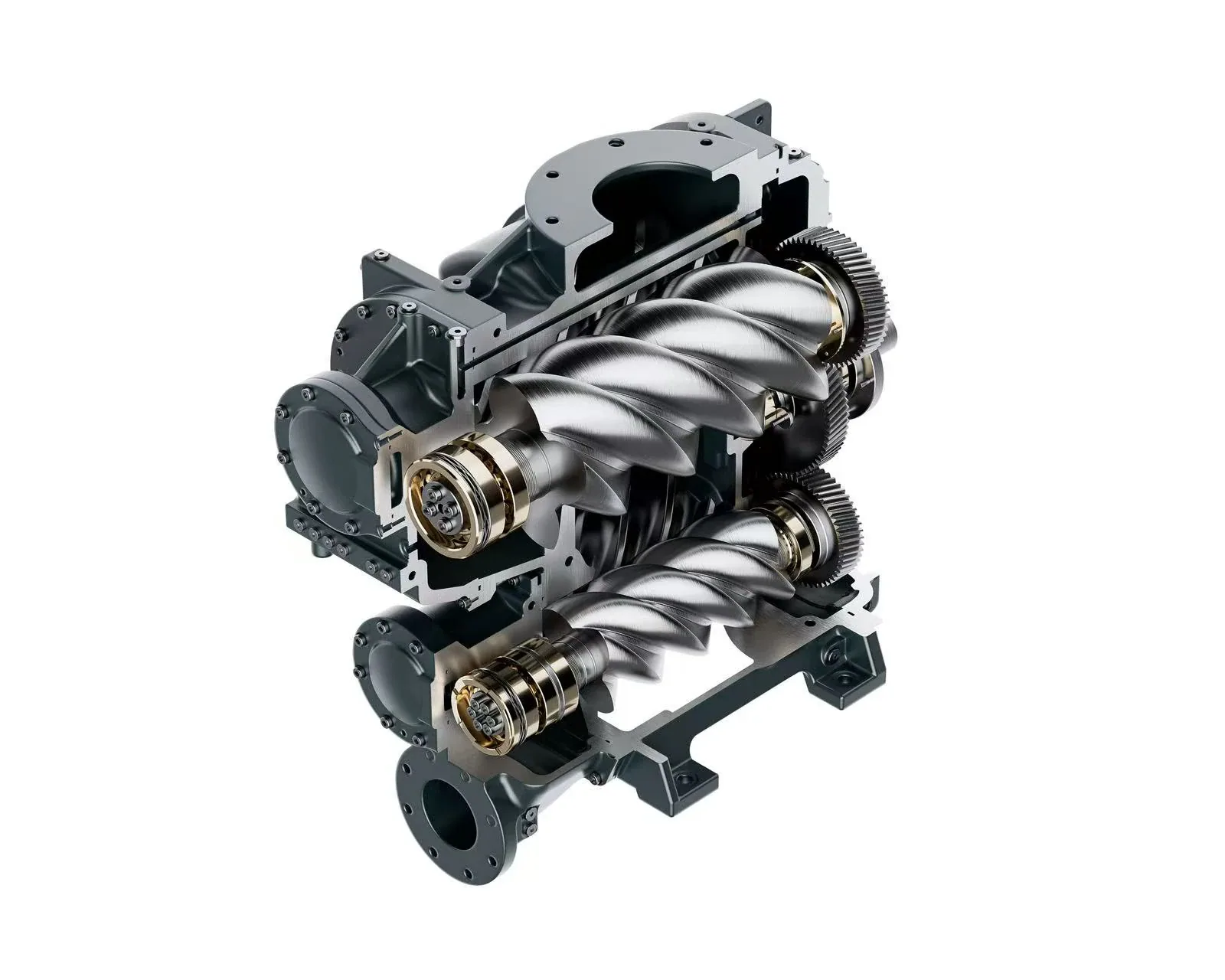
Ask to see where the airend is made or, if purchased, who makes it and under what long-term agreement. The airend is the heart of the screw compressor: its rotor machining tolerances, its bearing selection and its cooling design determine both efficiency and service life. A manufacturer who machines rotors in-house — or sources from a first-tier specialist under a stable contract — can explain the design choices. A supplier who cannot name the airend origin is selling you a sealed box.
Assembly and test benches
Walk the assembly line and look for three things: whether each station has defined torque and quality checks, whether finished units go to a test bench before packing, and whether the test bench records data per unit. A test bench that logs actual flow, pressure and power for each serial number is the physical evidence behind the performance claims in Layer 2. If the bench exists but nobody can show you a test record for a machine similar to yours, the process exists on paper only.
Pressure vessel and safety compliance
Receivers and any pressure-bearing components must comply with the regulations of the destination market — for Europe, the Pressure Equipment Directive and CE marking; for other markets, equivalent national rules. In the factory, this shows up as traceable material certificates and documented welding inspection. A supplier who assembles CE-compliant packages for EU customers routinely will have this documentation flow already organized; our article on SGS certification and EU CE marking shows what a complete compliance trail looks like in practice, and the compressed air storage tank product line illustrates the receiver side of the scope.
The spare parts warehouse
Ask to see it. The depth of a supplier’s own spare parts inventory tells you how it expects its machines to be serviced — including by you, years from now. A supplier who maintains stocked kits for its own installed base is planning for the machine’s second decade. One who orders everything against each new order is planning for the next sale.
Distributor, direct factory, or importing yourself?
A complete supplier evaluation also answers a structural question: through which channel should the machine arrive? The three common routes — local distributor, direct purchase from the factory, or direct import handled by your own team — distribute risk very differently, and the right answer depends less on the supplier than on your organization.
Local distributor. The distributor is your first line of service: commissioning, consumables, breakdown response. Evaluate the distributor as a company in its own right, separately from the factory whose machines it sells. How many technicians does it employ? Does it stock filters, oil and common spares in a local warehouse? How long has it represented this particular brand — a distributor that switches brands every few years will eventually switch away from the machine you bought? A strong distributor selling a mid-tier machine is frequently the better outcome than a weak importer selling a premium machine.
Direct from the factory. Buying direct shortens the commercial chain and usually improves pricing on larger scopes, but it transfers the distributor’s job to you and to the factory. This only works when the factory has genuine export infrastructure: its own service coordination for your region, a parts logistics channel that does not depend on your freight forwarder’s goodwill, and commissioning support in your language. During the evaluation, ask the factory to describe, step by step, what happens between delivery day and the first 8,000-hour service — the answer reveals whether “direct” means “supported” or merely “shipped”.
Direct import by your own team. Some plants import machinery routinely and have the staff to handle compliance, freight and installation contracts. Even then, keep the service obligations contractual with a named party. The single most expensive mistake in imported equipment is a machine with no one contractually responsible for its uptime — the warranty exists on paper, the spare parts exist in another hemisphere, and the production line waits for both.
Whatever the route, insist that one legal entity signs for the complete chain: machine, installation, commissioning and service. Fragmented responsibility is how disputes between the machine supplier and the installer consume months that your production schedule does not have.
Layer 4: The documentation package
Documentation is where supplier quality shows up without any visit at all. Request the full document package for the exact model under offer and evaluate it as part of the commercial bid, not as an afterthought. A serious package includes:
- General arrangement and dimension drawings with concrete foundation loads and service clearance requirements.
- Electrical schematics and wiring diagrams for the delivered voltage variant.
- Performance curves and the specific power figure under the agreed test standard.
- Air quality certificates where applicable, with certificate numbers.
- CE conformity declaration and risk assessment for EU destinations, or the equivalent for your market.
- Operating and maintenance manuals in the language of your technicians, matching the delivered controller.
- A spare parts list with prices — the actual list, not “ask us when you need something”.
- Recommended maintenance intervals and the tooling required for each task.
Read the manuals before signing. A manual that matches the delivered controller and includes real troubleshooting tables indicates a supplier who has delivered machines like yours before. A generic manual with placeholder screenshots indicates the opposite — and you will feel this difference every time your team opens the cabinet.
Reading the quotation itself as evidence
Long before the audit visit, the quotation document is already a sample of how the supplier works. Treat it as evidence and read it the way an auditor would:
- Scope boundaries. Does the offer state explicitly what is included — freight terms, installation scope, commissioning, training, first-fill of consumables — or does it list a machine price and leave everything else to be negotiated later? Suppliers who define scope precisely at the quotation stage rarely renegotiate it at delivery.
- Model traceability. Every line item should carry a model number that maps to a datasheet. An offer with “screw compressor 250 kW class, best configuration” is not an offer; it is a conversation starter with nothing to verify.
- Numbers that can fail. The strongest offers declare the specific power, the air quality class with certificate numbers, and the noise level — figures that can be checked at commissioning. Weak offers describe qualities with adjectives instead of quantities. When two offers differ mainly in adjectives, you are not comparing machines; you are comparing writing quality.
- Consistency across revisions. Ask for one revision, then another with a small change. If scope items silently disappear between revisions, note it — the same discipline will apply to the delivery documents.
There is a reason this matters more in compressed air than in commodity purchasing: the technical content of an air compressor offer is dense, and the buyer’s protection is entirely documentary. Machines are too big to return, energy consumption is invisible without metering, and air quality is invisible without laboratory sampling. The quotation is the first place where a disciplined supplier and a careless one separate.
Remote monitoring and data: who owns what
Modern screw compressors increasingly ship with controllers that log operating data and can transmit it — hours, loading, specific power trends, alarm history. In an evaluation, this is worth scoring, but with attention to ownership and continuity:
- Access: Can your team read the data directly, or only through the supplier’s portal? If the supplier’s portal is the only window, what happens if the commercial relationship ends?
- Standard protocols: Does the controller support Modbus or a comparable open protocol so your own building management or SCADA system can integrate it? An open protocol keeps your plant independent of any single vendor’s software.
- Alerting: Does the system push actionable alerts — filter differential pressure, high temperature trends — or only record history? Monitoring that requires someone to log in and look is monitoring that gets ignored.
- Data continuity: Ask what happens to historical data if the controller is replaced or the subscription lapses. The machine will outlive the software generation; your maintenance records should not be hostage to that cycle.
None of this is a reason to reject a supplier, but the answers reveal the supplier’s philosophy: vendors who design for their own lock-in describe the portal; vendors who design for the customer’s long-term autonomy describe the protocols.
Layer 5: The service network, in writing
Every offer includes the phrase “good after-sales support”. An air compressor supplier evaluation turns that phrase into obligations you can hold:
| Claim in the offer | What to ask for in writing |
|---|---|
| “Fast response time” | Committed response window in hours, per country, with the escalation path named |
| “Local service team” | Number of trained technicians in your region, and how they stay current on your model |
| “Spare parts available” | Which parts are stocked locally, which are factory-ordered, and the quoted lead time for each category |
| “Long warranty” | The exclusions list — warranty value lives in what it does not cover |
| “Remote monitoring” | What data is transmitted, who can access it, and what happens when the connection fails |
Two details deserve special attention. First, spare parts pricing: ask for the current price list of the top consumables — filters, oil, separator element — and compare it against the machine price. A low machine price with high captive consumable prices is a common structure; the honest comparison is done in the TCO article referenced above. Second, training: ask whether the supplier trains your technicians on first-line maintenance, and whether that training is included or billed. A plant that can do daily checks and filter changes itself dramatically reduces its dependence on any single service channel.
Layer 6: References and the questions that matter
References close the evaluation. Not logo walls — actual installations. Ask for two or three customers in your industry running a similar model under a similar duty, ideally in a comparable climate, and ask for permission to contact them. Two conversations with a plant that has run the machine for two years will tell you more than any factory tour: how the machine actually behaves in summer, how the supplier actually responds at 3 a.m., and whether the promised spares lead times hold.
When you do get a reference on the phone, skip the polite questions. The useful ones are concrete:
- “What failed in the first two years, and how long were you down?”
- “When you ordered the last filter set, how many days did it take to arrive?”
- “Does the measured energy consumption match the offer, and by how much?”
- “What do you wish you had negotiated differently?”
The last question consistently produces the most valuable answers, because reference customers have already paid tuition on the gaps in your checklist.
Layer 7: Commercial terms that decide year five
The final layer is contractual, and it is where suppliers quietly differ the most. Compare offers on these points before comparing them on price:
- Warranty scope: duration per component group (machine, airend, controller), the exclusions, and whether warranty requires using the supplier’s consumables exclusively.
- Consumable price protection: whether spare part and consumable prices are fixed for a period, or left open. An open-ended clause transfers all pricing power to the supplier after year two.
- Delivery and installation scope: who unloads, who installs, who commissions, who trains. “Ex-works” prices that look lower often simply move these costs to you.
- Commissioning records: whether startup includes a documented performance check against the quoted figures — this is your only chance to catch a gap between promise and delivery while it is still the supplier’s problem.
- Documentation for customs and compliance: for imports, the completeness of the CE/regulatory paperwork affects clearance time, and clearance time affects your project schedule.
Red flags: the short list
Across many evaluations, the same warning signs appear again and again. Any one of them deserves a hard question; two or more together deserve a walk-away:
- Specific power quoted without a test standard or a package boundary.
- Air quality certificate without a verifiable number or an issuing body.
- Refusal or hesitation to arrange a factory visit or live video walkthrough.
- A spare parts list with no prices, or prices dramatically above market norms.
- References offered only as logos, never as contacts.
- Warranty that excludes everything a compressor actually does — heat, dust, duty cycles.
- A quotation that changes scope silently between revisions.
A practical scorecard
To keep the evaluation disciplined across several suppliers, score each layer and weight it. The weights below are illustrative — adjust them to your plant’s risk profile — but the structure keeps the decision honest and comparable:
| Layer | Weight | Key evidence |
|---|---|---|
| Company verification | 10% | Factory confirmed, export track record, financial stability |
| Performance verification | 25% | Test standard named, package conditions declared, certificates verifiable |
| Factory audit | 15% | Test benches with records, QC stations, parts warehouse |
| Documentation | 15% | Complete package, manuals matching delivered hardware |
| Service network | 20% | Response commitments, local stock, training included |
| References | 10% | Contactable users in your industry and climate |
| Commercial terms | 5% | Warranty scope, consumable price protection, installation scope |
Notice what this weighting does: the machine’s quoted efficiency influences the outcome through the evidence it can produce, not through the size of the claim. A supplier who scores well here has demonstrated, layer by layer, that its promises are reproducible — which is the entire point of a supplier evaluation.
Where this fits in the buying process
Supplier evaluation sits in the middle of a sequence. Before it, you need the demand and sizing work — how much air, at which pressure, delivered to which points — which our articles on pressure drop and the differences between oil-free and oil-lubricated machines help to settle. After it, the shortlisted suppliers compete on measured total cost of ownership rather than on headline price. For readers building that full comparison, the oil-free selection guide and the machine-level differences between screw and piston technology provide the technical foundation the evaluation layers rest on.
Run this way, the process produces something better than a purchase order: it produces a supplier relationship whose promises were tested before you depended on them. In compressed air — where the machine runs every production day for two decades and the electricity bill quietly dwarfs the invoice — that is the difference between buying equipment and buying an outcome.
One last practical note for teams running this process for the first time: start the evaluation early, well before the machine is needed. Urgency is the enemy of verification. A buyer who needs air next month accepts the first credible offer; a buyer who begins the evaluation one quarter ahead can afford to be selective — and the suppliers worth selecting are exactly the ones that respect the process. Budget one or two weeks per layer, collect the evidence into a shared file as you go, and by the time the offers arrive, the decision will nearly make itself.